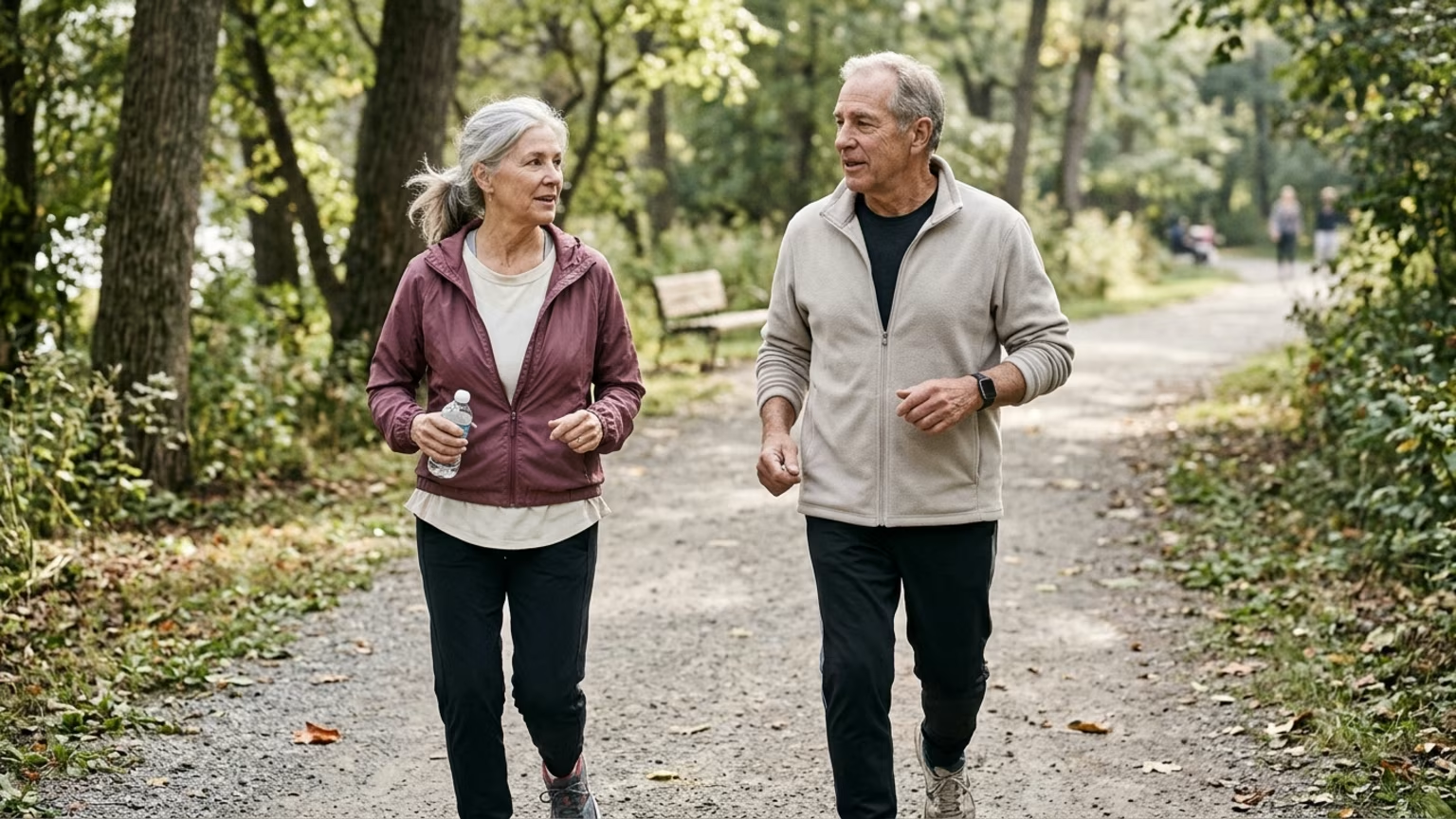

A large review linked leisure-time activity to lower dementia risk. See why the occupational finding is less certain and how to interpret both.





A meta-analysis published in The Lancet Public Health in September 2026 found different dementia-risk associations for leisure-time and occupational physical activity. According to Yahoo Health’s coverage, higher leisure-time activity was associated with lower risk. Higher occupational activity showed the opposite pattern.
The distinction raises a useful question for healthy aging: should movement be understood only by how much people do, or also by where and under what conditions it happens? The findings make that question worth examining without turning a population-level comparison into a verdict on anyone’s working life.
The paper, titled Domain-specific physical activity levels and risk of dementia: a systematic review and meta-analysis, examined activity in different parts of daily life. Its central distinction was between domains of movement rather than simply between active and inactive people.
Yahoo’s coverage describes leisure-time activity as including walking, cycling and running. Swimming and sports also belong in this category. Occupational activity can involve heavy lifting, repetitive tasks or prolonged standing.
These categories describe the setting of physical activity. A physically demanding shift and an activity outside work therefore belong to different comparisons in the review. Calling both “exercise” without further explanation would blur the question the researchers examined.
For readers whose jobs already involve substantial physical effort, that distinction matters. The research is asking whether activity in different settings has the same relationship with dementia risk. It is not merely comparing people who move with people who do not.
Yahoo reports that the meta-analysis combined 74 studies involving more than 4.2 million people across 30 countries. Participants were followed for a median of 10 years. The studies tracked all-cause dementia, Alzheimer’s disease and vascular dementia.
Compared with the least active groups, the reported estimates were:
These percentages describe relative differences between groups. They are not the proportion of participants who developed dementia, nor are they absolute percentage-point changes in risk.
The scale of the overall review is substantial. But the total number of participants should not be confused with the amount of evidence behind each activity category.
For readers also following research on movement and cellular aging, keeping the outcome clear is important. These dementia-risk estimates should not be repurposed as findings about skin, hair or visible aging.
The analysis was observational. As Yahoo explains, it identifies an association and does not demonstrate that occupational physical activity causes dementia. The difference between observing a pattern and establishing its cause is the central boundary around the findings.
The occupational comparison was based on five studies, compared with 20 studies for leisure-time activity. Those figures describe the evidence supporting each domain-specific comparison, not the full review. Yahoo also reports that household activity drew on just one study and commuting on two, making those results much less conclusive.
A secondary account of the paper reports that evidence certainty was very low to low. It also describes the occupational estimate’s confidence interval as close to the point of no association. That is important context for a headline percentage that might otherwise sound more settled than the evidence warrants.
The same account reports that the authors proposed stressful working conditions, reduced autonomy and hazardous exposures as possible explanations. These are hypotheses about factors that can accompany demanding work. They are not demonstrated biological mechanisms or proof that any one workplace condition explains the association.
The analysis also does not provide a personal dementia-risk estimate or establish an ideal leisure-exercise dose. It does not identify a particular activity that will prevent dementia. Its demonstrated result is a set of population-level associations, with considerably less evidence behind some activity domains than others.
The most useful practical context comes from the World Health Organization. WHO identifies physical activity as one of several healthy behaviors relevant to reducing the risk of cognitive decline and dementia.
Its broader approach also includes not smoking and eating a healthy balanced diet. Staying socially and cognitively active belongs in that picture, along with managing health conditions. Movement is part of a wider health strategy rather than a stand-alone guarantee.
For everyday decisions, the evidence supports a measured approach:
For someone with a physically demanding job, the useful response is not to label the working day as harmful. It is to keep the study’s narrower question separate from personal decisions about employment and health.
Readers interested in a wider movement perspective can also turn to Younell’s coverage of activity alongside recovery. That broader perspective fits the aim of understanding how habits sit within a whole life rather than judging health through a single measure.
The next question is why leisure-time and occupational activity showed different associations. Stronger evidence could help distinguish the role of movement itself from the working conditions that accompany it. A larger occupational evidence base would also make that comparison more informative.
For now, the clearest takeaway is specific: higher leisure-time activity was associated with lower dementia risk in this review. The occupational result deserves further study rather than an alarming interpretation. Placing movement within WHO’s broader approach to healthy behaviors offers a steadier foundation than treating either headline percentage as a personal forecast.
Stay connected for research and practical guidance on skin, hair, collagen, nutrition and beauty longevity. Clear ideas for people who want to understand how appearance changes with age and make better-informed choices over time.



Understand your skin, hair and body better without chasing every new trend, treatment or promise.
explore the Blog