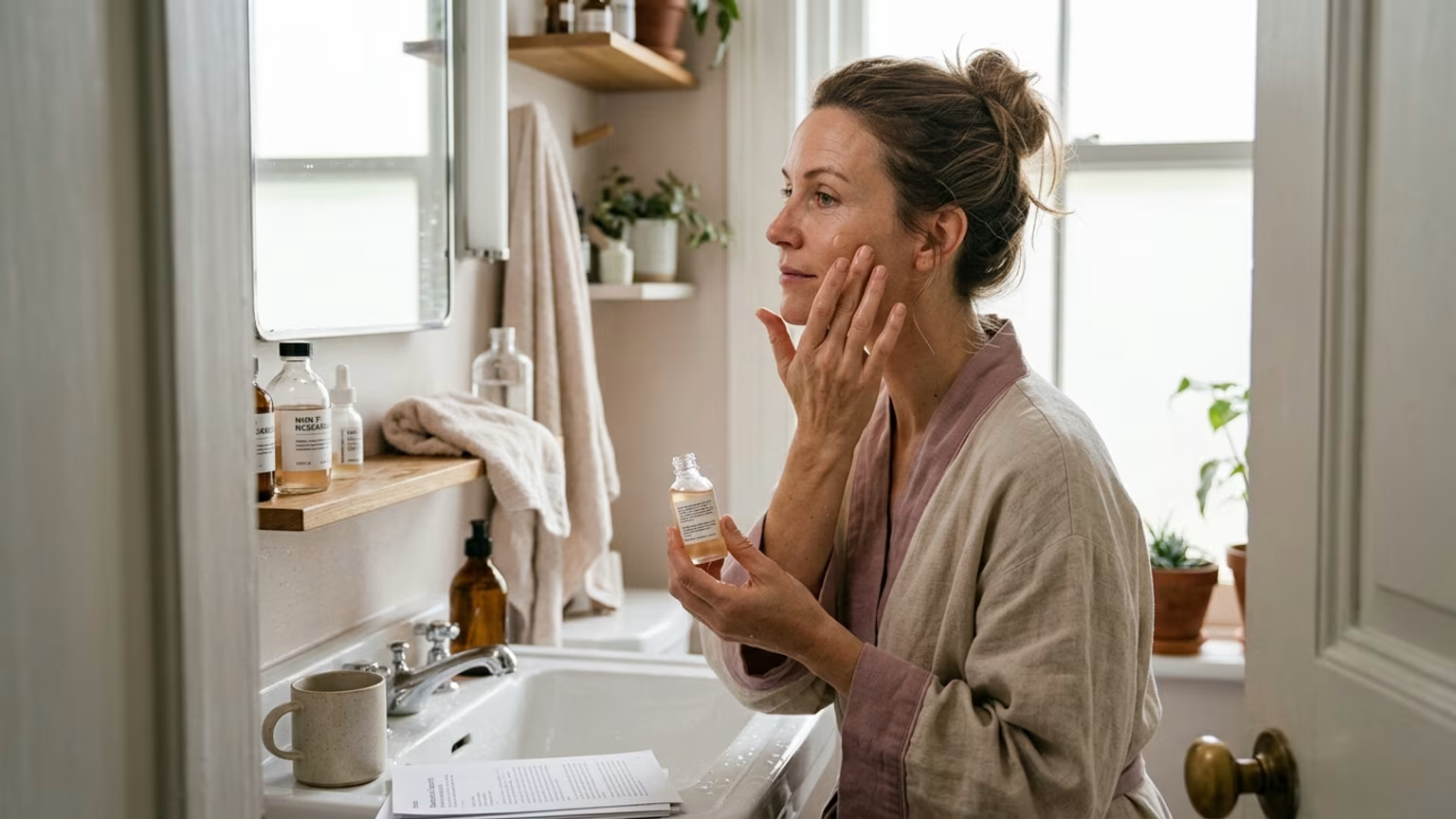

Learn how topical NMN is being researched for collagen support and skin firmness. We review recent laboratory data, stability metrics, and study limitations.





In September 2026, Cosmetics Daily published an updated ingredient profile on nicotinamide mononucleotide. The profile highlighted a 2025 study from the Journal of Cosmetic Dermatology that examined how this compound behaves in laboratory settings. Researchers tested the ingredient within a yeast-fermented filtrate to understand its effects on cellular responses. This update clarified how NMN is currently being positioned in skincare research rather than presenting it as a guaranteed cosmetic solution.
The primary Cosmetics Daily page presents NMN as an emerging skincare ingredient associated with NAD+ pathways. The publication lists proposed roles in collagen support, skin elasticity, hydration, and barrier repair. It is crucial to understand that these are ingredient profile claims rather than proof of clinical benefits in human users. The distinction between a proposed biological mechanism and a demonstrated cosmetic result is a fundamental principle of evidence-based beauty publishing.
To understand the appeal of topical NMN, we must look at how cells maintain their structure over time. NMN is associated with NAD+ pathways, which are essential for cellular energy and repair functions. Cosmetic chemists are investigating whether applying this precursor directly to the skin can support these pathways locally. According to the Cosmetics Daily update, this mechanism is proposed to help with barrier repair and skin renewal.
The laboratory findings offer a glimpse into how this ingredient might function at a cellular level. In the cited study, researchers applied the NMN formulation to human dermal fibroblasts. Fibroblasts are the specialized cells responsible for producing structural proteins in the dermis. The researchers reported an increase in type I collagen production within these treated cells.
These specialized cells act as the primary manufacturing centers for the scaffolding that keeps mature skin resilient. Protecting these structural proteins is a major priority for researchers focused on healthy aging. The laboratory increase in type I collagen provides a biological rationale for why brands are interested in NMN. However, laboratory success is only the first step in a long developmental process.
This specific type of collagen is a crucial component of a healthy dermal matrix. Understanding how the skin loses firmness requires looking at the biology of collagen breakdown over decades. Over time, environmental exposure and chronological changes degrade the structural integrity of the skin. Readers interested in this process can review our guide on how the dermal matrix changes over time.
The researchers tracked specific metrics regarding stability and absorption during their laboratory tests. They reported an approximately seven-month half-life at 20°C for the NMN in the yeast-fermented filtrate. This precise figure provides a baseline for understanding how long the active ingredient remains viable in that exact formula. A seven-month half-life means that half of the active compound degrades within that specific timeframe under controlled conditions.
However, this is a formulation-specific laboratory result, and it does not establish a universal shelf-life for all cosmetics. Shoppers cannot infer the stability of a different brand's NMN serum based on this single study. Formulating stable products is notoriously difficult, and delicate ingredients often break down before they ever reach the consumer. This highlights why clinical testing on final, retail-ready formulations is so critical for establishing trust.
The study also investigated how well the ingredient could penetrate a barrier. Researchers detected NMN in the papillary-dermis region of an artificial skin membrane. They did not detect the ingredient in the deeper subcutaneous tissue. While this artificial permeation is an encouraging data point for chemists, it represents a controlled model rather than human skin.
Human skin possesses a complex, living lipid barrier that often blocks topical ingredients from reaching deeper layers. The fact that the ingredient stopped at the papillary-dermis region in the laboratory model is an important detail. It suggests that while the molecule can penetrate the surface, its depth of delivery may be naturally limited. Formulators will need to address these penetration limits as they design consumer-ready products.
Scientific uncertainty remains a significant factor when evaluating these early laboratory results. The core limitation of the current data is the reliance on isolated cells and artificial membranes. Cultured fibroblast findings do not prove that an NMN cream will actually improve firmness or hydration on a living person. Translating a cellular response in a petri dish into a visible human outcome involves countless biological variables.
Cosmetics Daily explicitly characterizes topical NMN as an emerging ingredient. The publication notes that the topical evidence remains substantially less developed than the evidence for established ingredients. Proven staples like retinoids, niacinamide, and peptides have decades of human clinical data supporting their use. In contrast, NMN requires much more human testing before it can claim similar clinical validation.
Furthermore, the findings are entirely dependent on the specific yeast-fermented filtrate used in the study. We cannot automatically assume that every NMN serum will deliver the same collagen production or stability results. Different formulations, concentrations, and delivery systems can drastically alter how an ingredient performs on the skin. This distinction between laboratory models and consumer outcomes is a central theme in evidence-based beauty science.
The reality of cosmetic formulation is that ingredients must survive manufacturing, remain stable in a bottle, and penetrate the human stratum corneum. The gap between theoretical mechanisms and proven results is why many dermatologists prefer established actives. You can read more about this hierarchy of evidence in our overview of topical collagen care, retinoids, and vitamin C. Emerging ingredients often take years of rigorous testing before they match the reliability of proven staples.
Health-conscious women can realistically approach NMN as an interesting addition to a broader longevity routine. If you choose to try a product featuring this ingredient, treat it as an experimental step rather than a replacement for your core regimen. You should maintain your use of sunscreen, established antioxidants, and proven retinoids. These foundational steps provide the reliable protection and stimulation your skin needs over time.
When evaluating new product claims, pay close attention to the specific language used by brands. Marketing materials often translate proposed roles into guaranteed outcomes, which the current evidence does not support. Cosmetics Daily cautions against equating topical research with proven clinical efficacy. Consumers should view promises of instant structural changes with healthy skepticism.
You can learn more about finding reliable routines by visiting our beauty longevity blog. Look for products that combine emerging ingredients with robust, established actives to ensure you receive measurable benefits. By keeping your expectations grounded in the available evidence, you can make smarter purchasing decisions. Building a sustainable skincare habit relies on consistency with proven ingredients while staying informed about new developments.
As cosmetic chemistry continues to borrow from broader longevity research, our understanding of cellular energy will undoubtedly expand. Will future human clinical trials confirm the promising artificial membrane and fibroblast data we see today? The industry must bridge the gap between laboratory potential and real-world consumer outcomes. We have to wait and see how the science of topical NAD+ precursors evolves over the next few years as researchers move beyond the laboratory.
Stay connected for research and practical guidance on skin, hair, collagen, nutrition and beauty longevity. Clear ideas for people who want to understand how appearance changes with age and make better-informed choices over time.





Understand your skin, hair and body better without chasing every new trend, treatment or promise.
explore the Blog