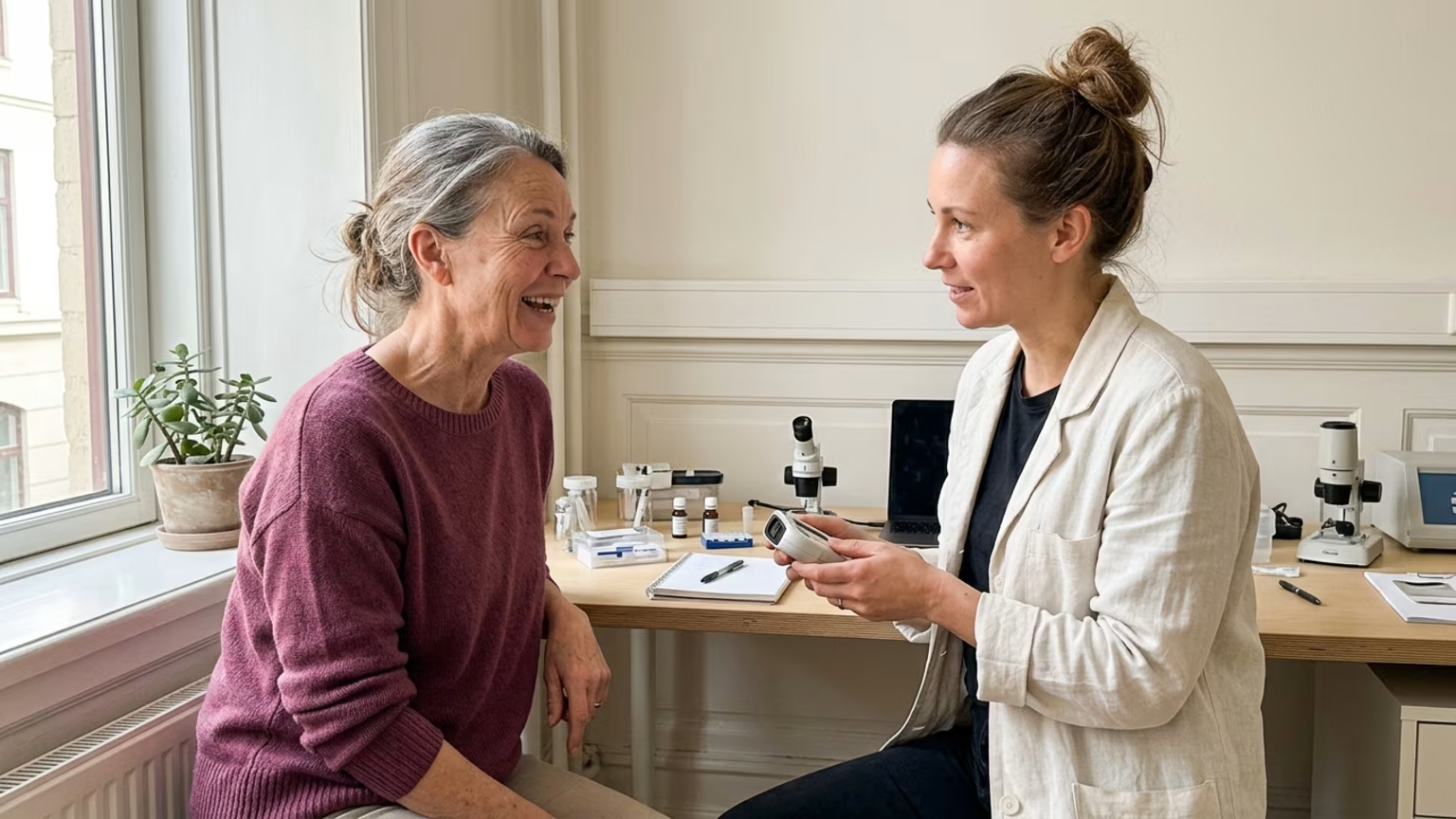

Discover the clinical evidence behind sunscreen, retinoids, and vitamin C for collagen care. Learn how to build an effective skincare routine.





The modern bathroom cabinet often looks like a small chemistry lab. Small glass dropper bottles line the shelves alongside tubes of prescription creams and heavy jars of moisturizers. Most of these products promise to rebuild skin structure, yet the visible results rarely match the heavy expectations placed on them. Finding reliable skincare information and routines requires looking past marketing hype.
The conversation around topical care often gets crowded with novelty ingredients. However, the most robust clinical evidence points to a much narrower, well-documented set of topical interventions.
The skin relies on a structural network of proteins to maintain firmness. Ultraviolet radiation accelerates visible skin changes by generating reactive oxygen species. This oxidative stress activates pathways that increase matrix metalloproteinases. These specific enzymes break down existing structural proteins and impair the production of new ones.
The skin matrix is a dynamic environment that constantly balances production and degradation. When reactive oxygen species flood the cellular environment, the body struggles to maintain this delicate equilibrium. The result is a net loss of structural integrity over time. A logical skincare approach aims to tip this balance back toward preservation and steady renewal.
The goal of an effective topical routine is to interrupt this degradation process. Sunscreen fundamentally acts as a shield against the initial ultraviolet trigger. Vitamin C works as an antioxidant to help neutralize the oxidative stress that bypasses sun protection. Retinoids operate differently by acting through retinoic-acid-responsive pathways to encourage epidermal turnover and dermal remodeling.
The Nambour randomized trial in Australia provides some of the most compelling evidence for long-term prevention. Researchers followed 903 adults for approximately 4.5 years to observe photoaging outcomes. The trial reports that daily sunscreen use produced approximately 24% less visible aging than discretionary use. Participants assigned to daily application showed no detectable increase in measured skin aging during the study period.
For direct remodeling, a reported meta-analysis of eight randomized trials examined topical tretinoin. This analysis involved 1,361 participants and found significant improvements in both fine and coarse facial wrinkles compared with a vehicle treatment. These trials included treatment periods ranging from 16 weeks to two years. The data shows that meaningful improvement requires consistent application over many months.
Vitamin C also shows positive signals in smaller clinical settings. One double-blind study of 10 participants using 10% topical vitamin C for 12 weeks reported improvements in photoaged scores and wrinkling. Another study followed 20 participants using a 5% formulation for six months and noted clinical improvements in furrows. A separate report noted an increase in dermal papillae density during a four-month study using 3% topical vitamin C.
The timelines observed in these clinical studies provide a crucial reality check for consumers. A 12-week or six-month study demonstrates that a specific effect was observed under highly controlled research conditions. It does not mean every commercial product with the same advertised percentage will produce identical, immediate results. Meaningful biological changes in the dermis require extended periods of continuous, undisturbed application.
Scientific studies happen under highly controlled conditions that do not always match everyday habits. The Nambour trial assessed surface microtopography rather than directly measuring total dermal structural protein content. Furthermore, the strong evidence for prescription tretinoin does not automatically apply to every cosmetic retinol derivative. Retinoid clinical trials also highlight irritation as a major hurdle, which can easily undermine effectiveness if users quit due to peeling.
Vitamin C studies carry their own set of significant caveats. The cited trials often involve very small groups, so they offer useful signals but not definitive proof of a universal effect. Product stability, packaging style, and pH heavily influence whether a serum actually reaches the intended target. A formulation needs a pH below 3.5 to improve stability and permeability, yet many consumer products lack this precise balance.
The language used in dermatology reviews must also be read carefully. While retinoids are often called standard topical therapies, the clinical evidence is strongest specifically for prescription tretinoin. Results from prescription tretinoin should not automatically be used to make equivalent claims for low-strength retinol products. Cosmetic retinol, retinal, and retinoid derivatives all have differing levels of evidence and stability.
Another common misunderstanding revolves around the word collagen in product marketing. Topical formulations containing this ingredient may primarily improve surface hydration rather than rebuilding internal structure. The search evidence describes topical recombinant formulations as capable of hydrating the surface and improving barrier feel. However, delivering intact large proteins deep into the dermis remains a significant biological challenge.
Dermatology-oriented guidance consistently places broad-spectrum sunscreen at the center of any morning routine. You should apply an SPF 30 or higher product daily and reapply during extended outdoor exposure. Sweating and swimming reduce practical protection, making reapplication far more important than hunting for an unusually high SPF number. This protective step is a crucial part of skin longevity and healthy aging.
When applying your morning sunscreen, volume and consistency are critical factors for success. Outdoor activity, heavy sweating, swimming, and towel drying all reduce practical protection significantly. Reapplication is vital to maintaining the barrier against oxidative stress throughout the day. Relying solely on a single morning application often leaves the skin vulnerable by the afternoon.
If you choose to incorporate topical vitamin C, prioritize stability over high concentrations. L-ascorbic acid is the most biologically active form, but it is notoriously unstable and penetrates poorly. The formulation must be sufficiently acidic, ideally with a pH below 3.5, to improve permeability. Packaging also matters, as exposure to light and air rapidly degrades the active ingredient before you can finish the bottle.
Evening routines require a slow and careful approach to retinoids. You should start with a low frequency and increase usage only as tolerated to avoid severe dryness. Using a gentle moisturizer helps, and you should not interpret initial redness as proof of product efficacy. Expect to wait months to see measurable improvements in skin texture and coarse wrinkles.
Consulting a professional is important before introducing highly active ingredients. Pregnancy, significant eczema, rosacea, and severe dryness are all valid reasons to consult a clinician before beginning a retinoid. Realistically, true collagen care is about slowing further loss and supporting gradual remodeling. It is not about completely restoring the facial volume lost through natural aging.
A persistent belief suggests that maximum ingredient concentrations yield faster, more dramatic results. Marketing often highlights vitamin C serums pushed well past the standard 10% to 20% range. The reviewed evidence suggests that concentrations above 20% may add irritation without necessarily adding any measurable biological benefit. Skincare operates on a curve of diminishing returns where overly aggressive formulations simply cause barrier damage.
Another prevalent myth assumes that initial product irritation is a positive sign of cellular remodeling. Many people interpret redness and peeling as proof that a product is actively rebuilding the dermis. In reality, persistent inflammation indicates barrier compromise rather than superior efficacy. A product cannot provide long-term benefits if the user is forced to quit due to a compromised, burning skin barrier.
No, vitamin C cannot replace broad-spectrum ultraviolet protection. Vitamin C does not absorb ultraviolet radiation, and it only helps neutralize oxidative stress. Sunscreen remains the mandatory first line of defense to prevent initial cellular damage. These two ingredients work best as a complementary morning pair.
Topical products do not restore the facial volume lost through natural aging. While a meta-analysis showed improvements in fine and coarse wrinkles, these changes occur at the surface and superficial dermal levels. Retinoids support gradual epidermal and dermal remodeling rather than acting as a structural filler. Long-term consistency is required to maintain these visible improvements.
Not necessarily, as retinoids come with clear trade-offs. They are generally avoided during pregnancy, and they can cause intense stinging for those with severe dryness or eczema. The exact strength of evidence differs between prescription tretinoin and over-the-counter retinol, but so does the irritation potential. Consulting a clinician is the best path if you have sensitive skin.
Real dermal support requires patience, consistency, and a realistic understanding of what ingredients can achieve. At Younell, we believe true beauty longevity comes from protecting what you have and gently supporting its natural remodeling over time.
Stay connected for research and practical guidance on skin, hair, collagen, nutrition and beauty longevity. Clear ideas for people who want to understand how appearance changes with age and make better-informed choices over time.




Understand your skin, hair and body better without chasing every new trend, treatment or promise.
explore the Blog