
Discover why healthy skin aging relies on barrier resilience rather than aggressive exfoliation. Learn evidence-based routines for mature and menopausal skin.





You have likely heard that aggressive exfoliation and high-strength acid combinations are required to treat mature skin. The biological reality is quite different. The most effective approach for healthy aging relies on epidermal resilience rather than constant disruption. A barrier-first routine prioritizing gentle care provides a more sustainable path to long-term skin health.
This misconception grew from a market emphasis on visible short-term transformation. Immediate smoothness after an intensive peel often reflects temporary surface desquamation or hydration. Consumers are frequently told that stronger formulas always yield better results. The emphasis on high-strength retinoid layering creates unrealistic expectations about daily maintenance.
Our team at Younell often reflects on this pattern. "When we first started reviewing clinical trials on collagen supplementation, I was struck by how often the media misinterpreted the data," we often recall. "A study showing a minor increase in skin elasticity was suddenly headlined as a fountain of youth."
"It made me realize how desperately consumers need a translator for beauty science, someone who can say exactly what a study proves and what it does not prove." This exact communication challenge applies to barrier health.
The skin barrier is primarily located in the stratum corneum. Here, skin cells called corneocytes are embedded in an organized lipid matrix containing ceramides, cholesterol and free fatty acids. Barrier function also depends on natural moisturizing factor, filaggrin-derived products, tight junctions, surface pH and inflammatory signaling. Researchers widely use transepidermal water loss, or TEWL, as a non-invasive proxy for epidermal barrier integrity.
TEWL measures the passive movement of water through the stratum corneum. Higher TEWL generally indicates that the barrier is allowing more water to escape. However, readings can vary with body site, temperature, humidity and recent product application. Epidermal lipid production and composition change with aging.
Disturbances in ceramide synthesis have been linked with impaired barrier function and increased TEWL. These changes are particularly relevant in the context of photoaging and glycation. Age-associated skin changes also include reduced sebaceous activity, altered hydration and surface pH. Furthermore, mature skin often experiences impaired barrier recovery and chronic low-grade inflammation.
Age-related reductions in sebaceous activity may alter the environment in which resident microorganisms live. These shifts can make mature skin feel drier and less tolerant of repeated irritation. While there is a biologically plausible connection between aging and increased water loss, this does not establish that every older person has elevated TEWL.
A barrier-first approach does not mean you must never exfoliate. The American Academy of Dermatology advises that different skin types tolerate different methods. Mild chemical exfoliation may suit some dry or sensitive users better than mechanical scrubs. The key is to match the intensity and frequency to your personal tolerance and baseline dryness.
Microbiome science adds another layer of complexity to this conversation. Skin microorganisms can interact with epidermal lipids and immune defenses. Experimental work cited in a recent review suggests that microbial sphingomyelinase activity can increase cutaneous ceramide content. This activity may reduce TEWL after barrier disruption.
However, a separate review states that microbiome-targeted interventions currently have stronger mechanistic and preclinical support than standardized clinical validation. Current microbiome-treatment evidence remains heterogeneous. Studies show wide differences in microbial strains, formulations, study designs and barrier endpoints. The clinical case for microbiome-targeted products is therefore less mature than the underlying biological rationale.
Finally, TEWL provides an instrumental measure of water loss but not a complete definition of healthy skin. A lower TEWL reading does not automatically mean increased collagen or fewer wrinkles. An improvement in TEWL does not necessarily translate into a reversal of biological age.
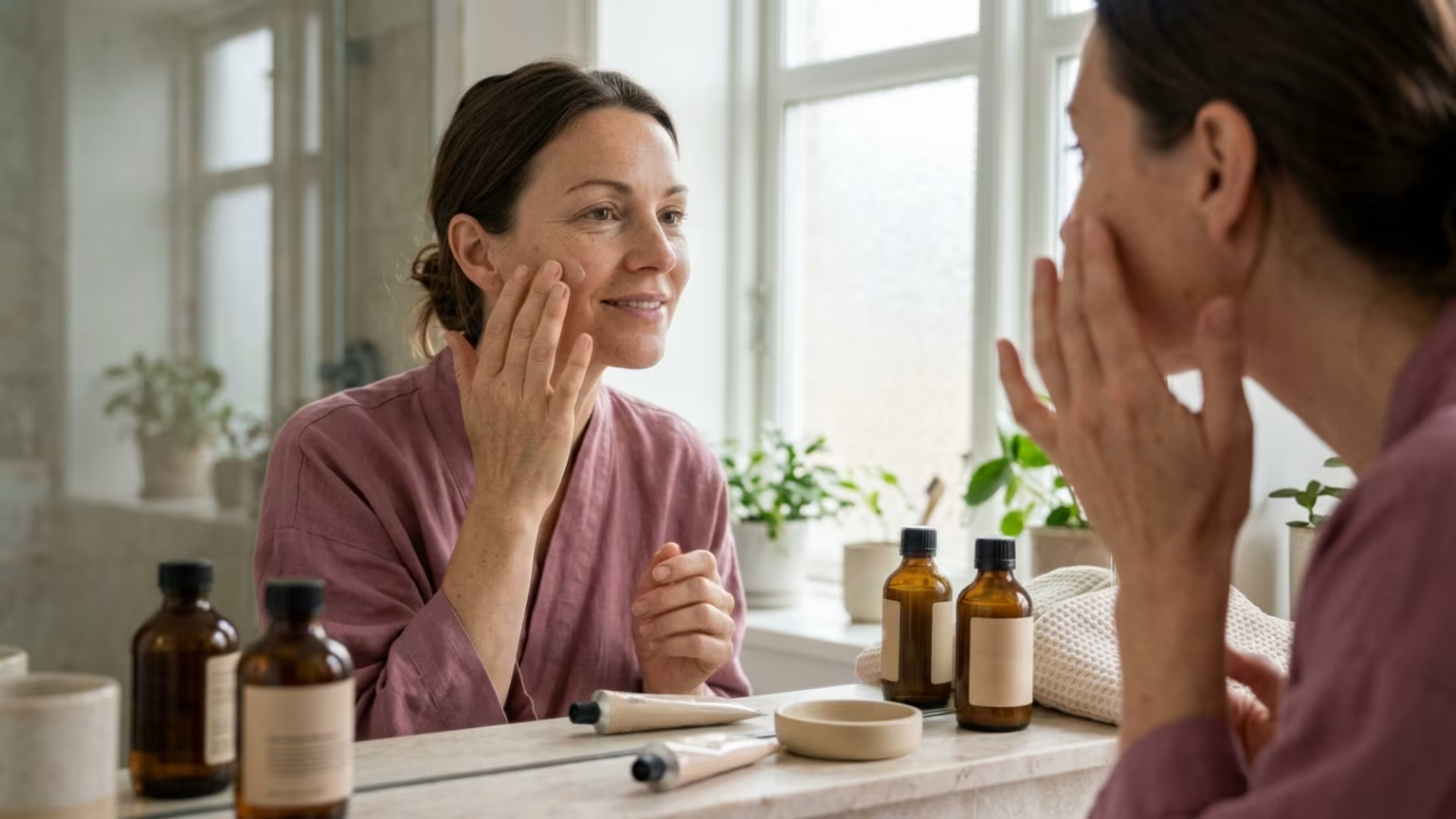
The foundation of a resilience-focused routine is gentle cleansing. The AAD recommends that people in menopause use a mild cleanser rather than soap. Soap can be excessively drying for mature skin. A useful personal test is whether the skin feels comfortable after washing and remains comfortable until moisturizer is applied.
If a cleanser consistently causes tightness or stinging, you should make adjustments. Reducing cleansing frequency and using lukewarm water are reasonable first steps. You must also respect your skin's recovery capacity when introducing active ingredients. The AAD advises people to consider existing retinoid, retinol or benzoyl-peroxide use before exfoliating.
Combining these ingredients with exfoliation may worsen dryness or irritation. You should introduce one active at a time and start at a low frequency. The AAD specifically warns that active ingredients can do more harm than good when too much is used. Avoid applying multiple potentially irritating actives on the same night.
Moisturizers support the barrier through different complementary mechanisms. Humectants like glycerin and hyaluronic acid help increase water content in the stratum corneum. The AAD recommends considering ingredients such as hyaluronic acid or glycerin for menopausal dryness. Emollients improve the flexibility of rough skin, while occlusives reduce water escape.
Barrier lipids are intended to support the stratum-corneum lipid matrix directly. Ceramide-containing formulations have clinical evidence for improving hydration and reducing TEWL in certain barrier-impaired conditions. These conditions include atopic dermatitis. However, results from disease-focused studies should not automatically be generalized to universal healthy aging benefits.
If a product improves subjective dryness and tolerability, it is still highly valuable for a consistent healthy aging and longevity routine. Photoprotection remains the most crucial active step in any regimen. Ultraviolet exposure contributes to visible wrinkles and can damage epidermal structure and lipid metabolism. The AAD recommends broad-spectrum sunscreen with SPF 30 or higher for reducing ultraviolet exposure.
Exfoliation remains a useful targeted tool when applied correctly. It may improve the appearance of surface roughness. However, aggressive exfoliation can be counterproductive for people navigating major hormonal shifts. You should exfoliate only when you have a defined goal and use the least aggressive method possible.
The AAD cautions that the skin becomes thinner at menopause. Therefore, at-home exfoliation or microdermabrasion may cause harm in some users. Always follow exfoliation with a moisturizer to support recovery. You should stop using products that sting or burn unless they have been prescribed by a dermatologist.
The AAD recommends applying treatment after cleansing and then following with moisturizer and sunscreen. Taking a measured approach helps manage chronic skin inflammation effectively. A routine that includes daily sunscreen but fewer irritating actives may be more sustainable. Highly intensive routines that repeatedly cause inflammation often lead to discontinuation.
Prioritizing epidermal resilience changes how we approach long-term skin health. You do not need to subject your face to constant irritation to age well. Supporting your lipid matrix, managing hydration and protecting against ultraviolet damage offer a sustainable strategy.
Chronological aging, menopause and environmental exposure will inevitably influence your barrier profile. By observing how your skin responds to each step, you can build a routine that actually supports biological function over time. True resilience is built through consistent, gentle maintenance rather than aggressive intervention.
Stay connected for research and practical guidance on skin, hair, collagen, nutrition and beauty longevity. Clear ideas for people who want to understand how appearance changes with age and make better-informed choices over time.


Understand your skin, hair and body better without chasing every new trend, treatment or promise.
explore the Blog