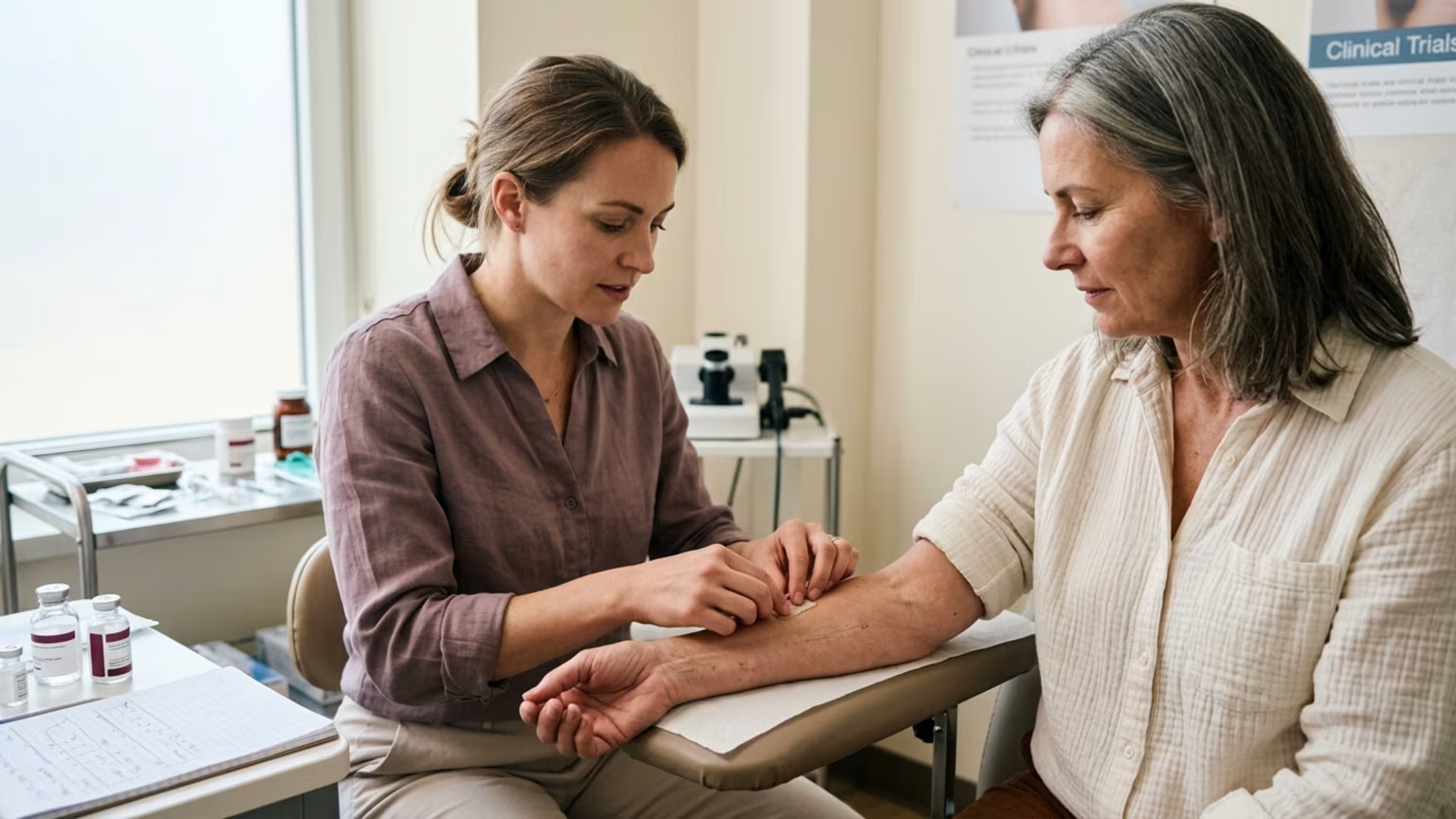

Read the science behind exosomes in beauty. Understand how extracellular vesicles work, the limits of current clinical evidence, and FDA regulatory status.





If you are noticing changes in your skin texture or firmness, you are likely wondering: Do exosome serums and treatments actually rebuild collagen and restore skin health? Here is the science-backed answer.
Exosomes are small particles released by cells that carry proteins, lipids, and nucleic acids. They are a specific subset of extracellular vesicles that function as a cellular communication system. When cells release these tiny packages, they send instructions to neighboring tissues. The beauty industry is heavily focused on how these signals might alter skin behavior.
In proposed skin repair mechanisms, this vesicular cargo may influence multiple biological pathways. Research indicates they can affect cell proliferation, tissue migration, and extracellular-matrix remodeling. They are also studied for their role in modulating inflammation and blood vessel formation. Some studies describe the activation of specific tissue repair pathways that increase collagen production.
The biological rationale for these treatments is certainly plausible. Vesicles can act as transport vehicles to deliver genetic information between cells. This transfer process might stimulate sluggish cellular machinery in aging skin tissues. However, researchers are still mapping exactly how these signals behave once applied outside a controlled laboratory environment.
It is also important to distinguish between purified preparations and broader cellular secretomes. A secretome is a conditioned medium containing a wide mixture of cellular byproducts. These two materials can differ significantly in their composition and required quality control measures. Treating these different biological fluids as scientifically interchangeable creates confusion for consumers.
The current human evidence for aesthetic skin rejuvenation remains highly limited. A recent dermatology review notes that most evidence comes from isolated cell and animal studies. Relatively few human trials are adequately designed or statistically powered to confirm cosmetic benefits. This means the biological theory is plausible but not clinically validated for routine aesthetic use.
A dermatology review examined clinical trial registrations as of September 2025. It found 25 clinical trials for dermatologic conditions registered on ClinicalTrials.gov. Only seven of these trials were listed as completed. The registered indications focused on medical conditions like wound healing, psoriasis, and diabetic ulcers rather than cosmetic facial aging.
The registered trials tracked by researchers show broad interest across medical disciplines. However, the relatively small number of completed dermatology studies indicates that the field remains highly developmental. Many registered trials were listed as recruiting or had entirely uncertain status. The clinical evaluation process has simply not caught up to the commercial enthusiasm.
One observational pilot study from 2026 looked at just 14 women. The participants received microneedling followed by a topical formulation derived from Panax ginseng. Investigators reported short-term patient observations without serious adverse events during a brief follow-up period. Because this pilot lacked a control group, it cannot prove that the botanical formulation caused the reported improvements.
Understanding this research is vital for beauty science literacy. Biological plausibility is not clinical validation. A vesicle can carry signaling molecules and alter cultured cells without producing a meaningful, durable, or safe improvement in people. Stronger evidence is necessary before classifying these materials as proven treatments.
The word exosome describes a general delivery platform rather than a uniform ingredient. Products differ drastically based on their source cells, donor characteristics, and purification methods. Extracellular vesicles derived from adipose tissue, bone marrow, and plant sources carry entirely different biological cargo. This manufacturing variability affects both the biological activity and the potential risks of the final preparation.
Measurement and quality control present massive hurdles for the industry. Differences in laboratory instruments and analytical pipelines can produce different measurements from the exact same sample. This variability complicates direct comparisons between published scientific studies and commercial skincare products. Research groups are increasingly emphasizing rigorous potency testing rather than relying on basic product labels.
Many clinics advertise high particle concentrations to suggest better treatment results. However, aesthetic medicine commentary and regulatory literature caution against relying on this metric alone. Particle count cannot establish a product's purity, specific cargo consistency, or overall sterility. A high concentration of vesicles does not guarantee clinical equivalence to the materials used in published scientific research.
The field is also moving beyond naturally occurring vesicles toward engineered alternatives. Scientists are developing drug-loaded vesicles, artificial variations, and antibody-modified particles. While these approaches may increase cargo control, they introduce additional questions regarding immune activation and toxicity. Consumers evaluating cellular aging and beauty claims must recognize these profound manufacturing complexities.
In the United States, no exosome product has FDA approval for any indication. The FDA has clearly stated that claims suggesting these products fall outside standard biologic regulations are incorrect. Products intended to treat diseases or conditions in humans are generally subject to premarket review. Availability at a local clinic or online store does not establish regulatory approval.
The regulatory science literature argues that these clinical products should undergo rigorous review. Efficacy evaluation has simply not been completed broadly enough to support routine therapeutic claims. The agency issued a public safety notification in December 2019 regarding unapproved products. This notification followed reports of serious adverse events among patients treated with materials marketed as containing exosomes.
Regulatory enforcement activity remains highly relevant to the aesthetics sector today. In August 2026, the FDA issued a warning letter to R3 Medical Companies. The agency characterized the marketed products as unapproved new drugs. The letter cited specific provisions of the Federal Food, Drug, and Cosmetic Act.
Consumers must understand how topical cosmetics are classified under these regulations. A cosmetic marketing claim has different legal implications than a claim to alter bodily structure. You should never infer that a topical label has been FDA-approved merely because it is sold as skincare. Careful language is necessary to distinguish between an unapproved biologic drug and a topical cosmetic serum.
You should evaluate these treatments by separating the active product from the delivery method. Clinics often pair these vesicle products with established procedures like microneedling or fractional laser therapy. This combination makes it difficult to determine what actually caused any visible skin improvements. The benefit might come entirely from the skin's natural response to the physical procedure.
Do not assume that topical application is entirely free of risks. Applying a serum immediately after microneedling involves an intentionally disrupted skin barrier. This delivery method introduces critical questions about product sterility, formulation contamination, and inflammatory risks. Evidence for a combined procedure cannot automatically be generalized to an untouched skin serum.
Treat marketing terms like regenerative or cellular communication as descriptions of a proposed mechanism. They are not proof that a finished product improves wrinkles, pigmentation, or hair density. You should ask your provider if the scientific evidence compares the exact product against a placebo. Request data showing how many participants were studied and whether outcomes were measured objectively.
Before committing to a treatment, ask for the exact product name and source material. Inquire about the specific particle testing, sterility validation, and endotoxin data performed on that batch. It is reasonable to compare these offers with better-established skin longevity tools. A cautious consumer will view these procedures as investigational until stronger controlled human evidence exists.
Significant long-term questions remain open regarding the routine use of these materials. The available sources identify a clear need for better evidence concerning treatment durability and biodistribution. Researchers also require more data on potential immunogenicity, dose-response relationships, and long-term storage stability. Without this foundational data, consumers carry the burden of unknown clinical variables.
While cellular signaling vesicles represent a fascinating frontier in biological research, prioritizing treatments with established clinical safety remains the most reliable path to beauty longevity.
Stay connected for research and practical guidance on skin, hair, collagen, nutrition and beauty longevity. Clear ideas for people who want to understand how appearance changes with age and make better-informed choices over time.



Understand your skin, hair and body better without chasing every new trend, treatment or promise.
explore the Blog