

Cosmax announced an AI model predicting alopecia areata risk using 22 million health records. Read our breakdown of this early-stage scalp biology research.





In September 2026, the beauty and health research company Cosmax announced the development of a novel artificial intelligence model. The company reported filing a patent application for a system intended to predict the risk of alopecia areata. This model was trained using approximately 22 million health-screening records from South Korea and Japan. Examining large datasets is becoming a notable approach to understanding complex dermatological conditions.
This announcement highlights a growing trend of utilizing massive health archives to inform beauty research. Historically, assessing hair health relies heavily on direct physical observation. Shifting toward algorithmic predictions represents a different method of investigating long-term tissue changes. However, it is essential to view this specific announcement as an early-stage research development rather than a finalized clinical diagnostic tool.
Alopecia areata is a specific condition characterized by typically sudden, patchy, nonscarring hair loss. To understand potential risk factors for this condition, researchers analyzed historical health data rather than collecting new biological samples. Cosmax says its predictive model evaluates 33 distinct variables to generate a risk assessment.
These 33 selected variables cover several different categories of human health data. They include physiological and medical indicators, such as a person's blood pressure and liver-enzyme levels. The system also factors in various demographic and socioeconomic measures to complete its analysis. By evaluating these diverse data points, the model attempts to find statistical correlations that relate to the condition.
Alongside the AI model, the company shared findings from a separate research effort focused on physical scalp biology. Cosmax reported analyzing scalp lipid profiles from 387 participants of East Asian, European, and African descent. The researchers grouped the observed scalp profiles into three distinct categories.
During this classification process, researchers identified both shared lipid patterns and group-specific lipid patterns across the participants. The company stated that understanding these biological differences could guide future product formulations. Cosmax says it plans to use these specific findings to develop ethnicity-specific biomarker panels and cosmetic products.
It is important to clearly separate the AI risk model from the scalp-lipid analysis. The reported predictive model assesses alopecia areata risk strictly from broad health-screening variables. Meanwhile, the lipid work characterizes physical scalp profiles in a completely separate participant group. These two distinct efforts represent completely different methodologies for investigating the biology of human hair.
The sheer volume of the data used in the predictive model is certainly substantial. Training an algorithm on 22 million health-screening records provides a massive pool of baseline information. In contrast, the separate scalp-lipid analysis relied on a highly specific cohort of exactly 387 participants.
While processing millions of records is computationally impressive, it does not automatically guarantee predictive accuracy for an individual patient. Large dataset sizes show the capacity of the computing system. They do not demonstrate how well the resulting algorithm will perform when applied to a new person. Real-world medical outcomes often differ significantly from initial data modeling exercises.
The accessible event coverage did not provide critical performance metrics for the new AI model. There is no available data regarding the system's sensitivity, specificity, or false-positive rates. The reports also completely lack any comparison with standard clinical assessment methods.
Without these crucial clinical statistics, it is impossible to determine how reliably the tool performs in real-world scenarios. The large record count simply describes the volume of the initial computational work. Evaluating a medical tool requires clear evidence of accuracy, not just a description of the training data.
This research comes with several significant scientific limitations that require careful context. Primarily, the AI model is built to assess the risk of alopecia areata specifically. It is not designed to evaluate general thinning, hormonal changes, or other common forms of hair shedding. Readers should not interpret this announcement as a universal predictive tool for every type of hair concern.
Furthermore, there is no evidence that the predictive model has been tested in routine patient care environments. A tool developed in a research setting often requires extensive validation before it can be used in clinics. The lack of independent expert assessment in the available coverage means the clinical utility of the tool remains completely unproven.
The separate scalp-lipid findings also represent very early-stage biological research. The company's plan to develop specific biomarker panels and targeted products is merely a stated development goal. This announcement does not establish that these consumer diagnostics or treatments are currently available or clinically validated.
The research reports do not explain how the 387 participants were recruited. They also do not detail how the three distinct ancestry groups were defined during the study. There is currently no indication that the observed lipid patterns have been independently replicated by other scientists. Therefore, these early findings should not be treated as definitive biological rules for broad populations.
For women managing changes in their hair density, this announcement is an interesting look at future product development. It is definitely not a viable substitute for proper clinical evaluation by a qualified medical professional. Understanding the difference between shedding and clinical loss is a crucial first step when you notice sudden physical changes. If you are experiencing sudden, patchy hair loss, an immediate clinical assessment remains highly relevant.
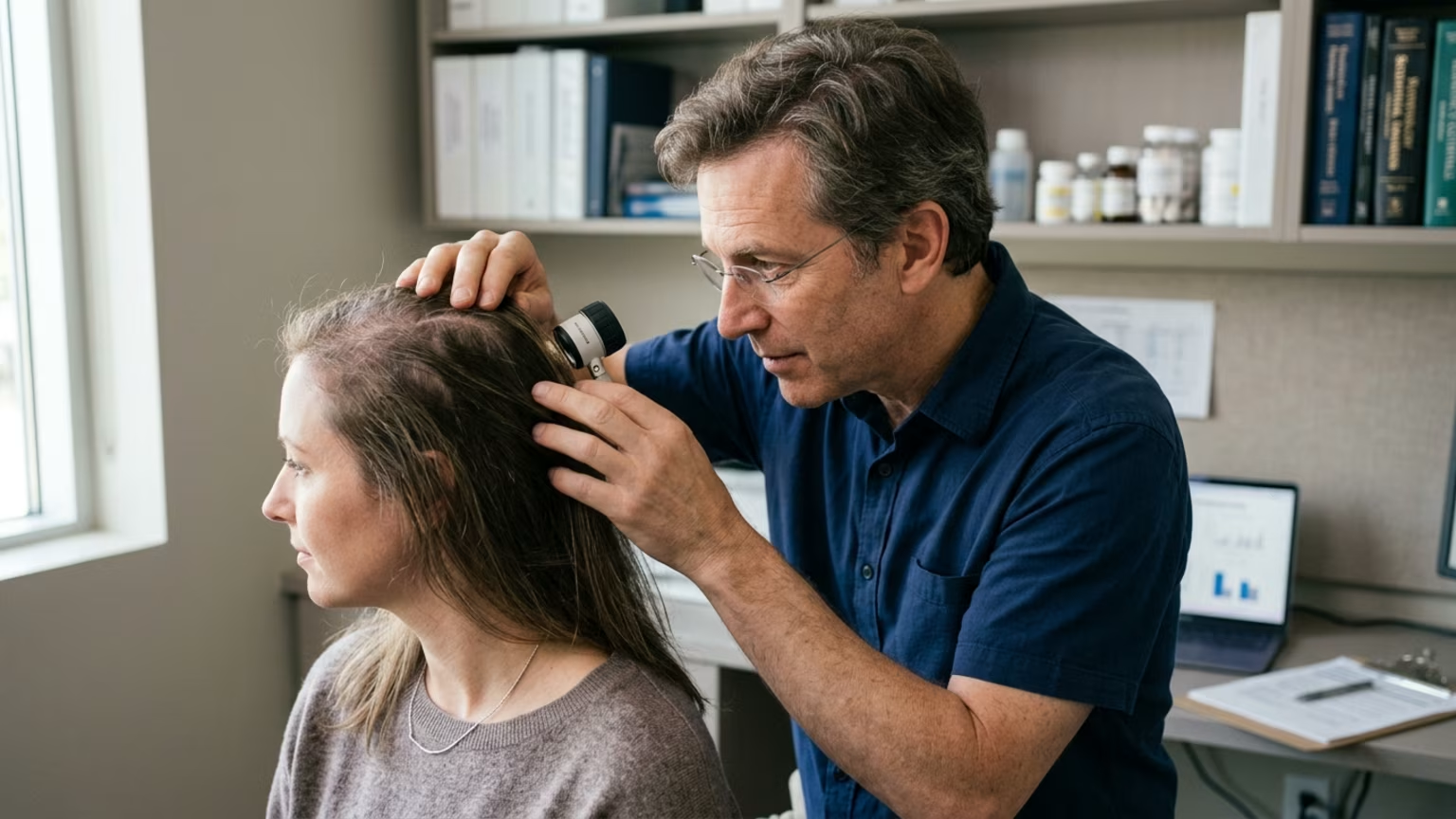
Hair loss can stem from multiple underlying physical causes that require careful investigation. The American Academy of Dermatology advises people to seek evaluation by a board-certified dermatologist for an accurate diagnosis. A medical professional will typically begin the diagnostic process with a thorough visual inspection of the scalp and nails.
Depending on the suspected causes, a dermatologist may also utilize targeted blood tests or perform a scalp biopsy. Learning exactly what to expect during clinical evaluation helps you take practical, evidence-based steps toward maintaining your physical health. A proper medical evaluation provides personalized insights that a general computational algorithm simply cannot offer.
Readers should treat any future consumer-facing risk score with a healthy degree of caution. Before trusting a digital predictive tool, you should look for published evidence regarding its validation and clear instructions for use. You can review established treatment protocols for common hair density changes to understand therapies that already possess strong clinical backing. Relying on proven medical advice will always serve your long-term goals better than waiting for emerging consumer technologies.
The integration of large-scale health records into beauty research points toward an increasingly data-driven approach to personal care. As researchers continue to map scalp biology and refine predictive algorithms, the overlap between clinical technology and daily routines will inevitably grow. Monitoring these developments allows health-conscious individuals to stay informed about the shifting landscape of beauty longevity. Will future diagnostic tools successfully bridge the gap between processing massive datasets and delivering clinically validated, highly accurate insights for the individual?
Stay connected for research and practical guidance on skin, hair, collagen, nutrition and beauty longevity. Clear ideas for people who want to understand how appearance changes with age and make better-informed choices over time.




Understand your skin, hair and body better without chasing every new trend, treatment or promise.
explore the Blog