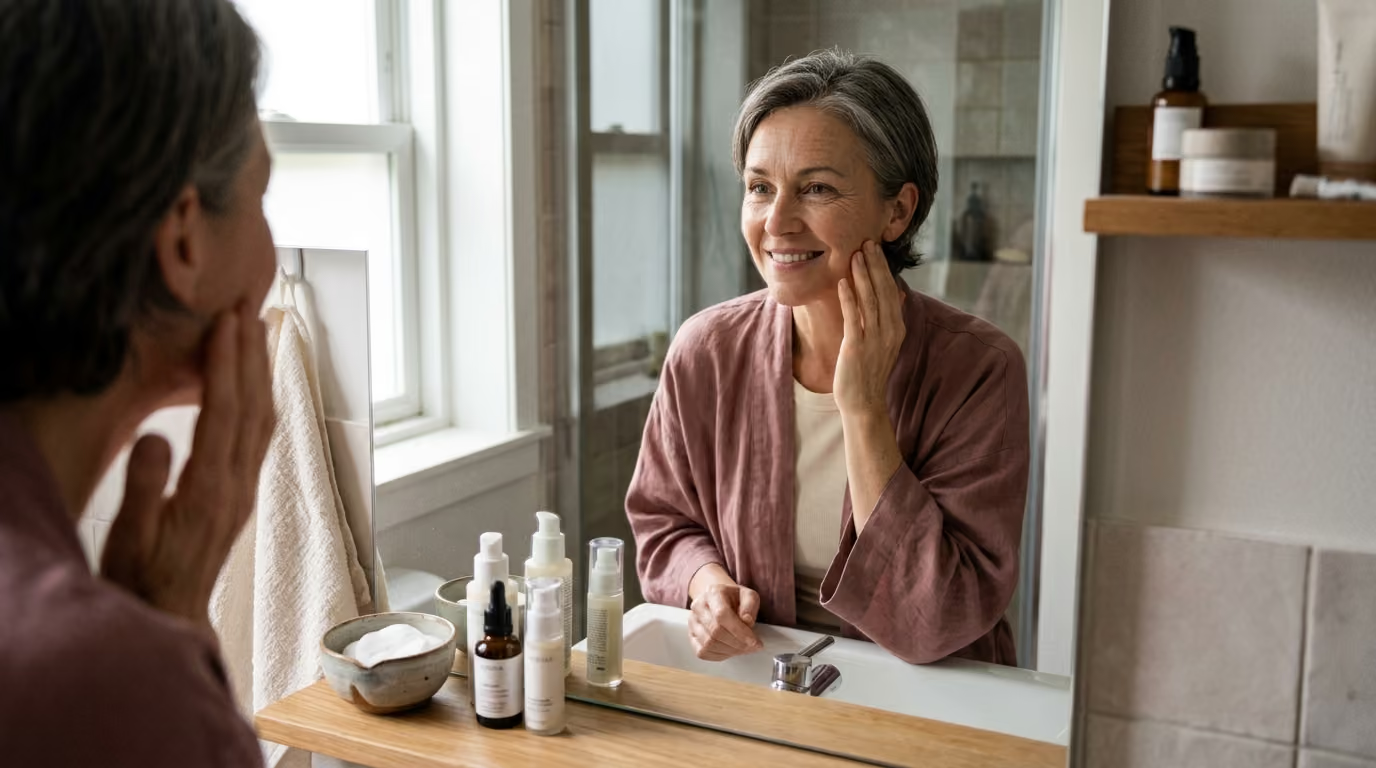

Complex multi-step skincare routines often trigger irritation, whereas sustainable skin longevity depends on evidence-based photoprotection.





You open your bathroom cabinet to find three serums, two exfoliants, a rich night balm, and several half-used sunscreens. Each purchase began with good intentions after reading a glowing review or watching a tutorial. Yet, your skin frequently feels tight, unpredictable redness appears without warning, and completing the full sequence feels like an exhausting chore. When life gets busy, the entire multi-step process collapses.
This cycle of intense experimentation followed by routine abandonment is remarkably common. True skin longevity does not come from accumulating specialized jars or chasing immediate cosmetic changes. It relies on treating your daily regimen as a long-term risk management and maintenance system.
Building a lasting regimen requires understanding biological priorities and removing unnecessary friction. When your daily habits support the skin barrier and shield against environmental damage, skin maintains its natural resilience over decades. This playbook provides a structured, evidence-based system to help you build, measure, and sustain a practical routine that fits your actual life.
The outermost layer of your skin, the stratum corneum, functions much like a brick wall. The skin cells, called corneocytes, act as bricks, while intercellular lipids serve as mortar. This lipid matrix consists primarily of ceramides, cholesterol, and free fatty acids. Together, they create an essential permeability barrier that retains moisture and shields living tissue from environmental insults.
When this barrier is intact, skin maintains optimal hydration levels through low transepidermal water loss. If the lipid matrix is stripped by harsh cleansers or over-exfoliation, microscopic cracks develop. Water evaporates rapidly, allowing irritants and pollutants to penetrate deeper into the epidermis. This triggers low-grade, persistent inflammation that can compromise healthy cellular function.
Beneath the barrier lies the dermis, where structural proteins provide firmness and elasticity. Type I and Type III collagen form a dense structural network, while elastin fibers allow the skin to stretch and bounce back. Fibroblasts continuously synthesize these proteins while matrix metalloproteinases break down damaged fibers in a balanced cycle of renewal.
Ultraviolet radiation disrupts this delicate biological balance. Ultraviolet B rays directly damage cellular DNA in the epidermis, leading to sunburn and mutations. Ultraviolet A rays penetrate deeper into the dermis, generating reactive oxygen species. These free radicals trigger an overproduction of matrix metalloproteinases, which rapidly degrade collagen and elastin fibers.
Over time, cumulative UV exposure causes structural disorganization, uneven pigmentation, and solar elastosis. Protecting the skin from UV radiation stops this accelerated breakdown at the source. This is why photoprotection remains the biological cornerstone of any routine designed for skin longevity and healthy aging.
Scientific literature clearly shows that regular, consistent habits produce the most reliable long-term outcomes for skin health. The strongest evidence for topical photoprotection comes from a randomized controlled trial conducted by Dr. Adele Green and colleagues. Published in the Annals of Internal Medicine, this 4.5-year trial evaluated 903 adults to measure the true impact of daily sunscreen application against discretionary use.
The trial results showed that the daily sunscreen group had no detectable increase in skin aging over the study period. Microscopic skin surface analysis revealed that daily users experienced 24 percent less skin aging progression than the control group. The reported relative odds were 0.76 with a 95 percent confidence interval of 0.59 to 0.98. This rigorous study confirmed that daily photoprotection reliably slows the rate of visible skin aging over multiple years.
Research into habit formation shows why maintaining such daily routines can be challenging. A landmark study led by Dr. Phillippa Lally at University College London tracked 96 participants forming daily health habits. The researchers measured automaticity over 12 weeks using the Self-Report Habit Index.
The data demonstrated that the time required to reach 95 percent automaticity ranged from 18 to 254 days. While the median timeline was approximately 66 days, the wide variation proves that habit adoption is unique to each person. Crucially, the mathematical modeling revealed that missing an isolated day did not derail the habit formation process. Consistency over months mattered far more than unbroken daily perfection.
Topical barrier repair research presents similarly grounded insights. Meta-analyses examining ceramide-dominant moisturizers show measurable improvements in clinical comfort, skin hydration, and eczema severity scores. However, several comparative studies show no statistically significant difference in transepidermal water loss when comparing ceramide creams to well-formulated standard moisturizers. A simple, well-tolerated moisturizer used consistently provides substantial biological support, regardless of premium branding.
While clinical studies provide valuable guidance, consumers must understand the limitations of skincare research. Many commercial product studies rely on short timeframes, often measuring changes over just four to twelve weeks. These short durations can demonstrate temporary surface hydration or mild plumping, but they cannot prove decades-long structural preservation.
Observational studies and laboratory cell cultures also have distinct boundaries. In vitro testing on isolated fibroblasts does not replicate the complex, living environment of human skin exposed to real-world pollution, weather, and psychological stress. A compound that stimulates pro-collagen in a petri dish may fail to penetrate the stratum corneum in daily human use.
Publication bias remains another important factor within cosmetic science. Trials funded by product manufacturers are significantly more likely to publish positive outcomes than neutral or negative results. Many commercial trials use small sample sizes, sometimes fewer than 30 participants, and lack rigorous double-blind controls.
Long-term randomized trials like the Green sunscreen study are exceptionally rare due to high costs and logistical complexity. Furthermore, the Green trial confirmed that daily sunscreen slows future UV damage, but it did not show that sunscreen reverses existing, deep dermal photodamage. Understanding these boundaries helps you evaluate marketing claims through an objective, scientific lens.
A sustainable regimen should be organized into four clear biological layers. This framework prioritizes the highest-value habits while preventing the friction caused by using too many products.
Photoprotection serves as the fundamental anchor of skin health. The American Academy of Dermatology recommends using a broad-spectrum, water-resistant sunscreen with an SPF of 30 or higher on all exposed skin. Broad-spectrum formulas defend against both UVB burning rays and UVA aging rays.
Comprehensive photoprotection extends beyond sunscreen lotion alone. A complete strategy integrates wide-brimmed hats, UV-blocking sunglasses, seeking shade during peak midday hours, and wearing sun-protective clothing. Real-world efficacy depends on applying adequate volume, roughly one nickel-sized amount for the face, and reapplying during prolonged outdoor exposure.
Barrier maintenance requires two core products: a gentle cleanser and a dependable moisturizer. Cleansing should remove dirt, sweat, excess sebum, and sunscreen without stripping natural intercellular lipids. Cleansers that leave the face feeling tight or squeaky disrupt the stratum corneum and should be replaced with milder formulas.
Moisturizers support the barrier through three complementary mechanisms:
In our examination of lifestyle and environmental aging, our team evaluated how daily habits influence barrier resilience. In our experience, simple habits like sleep and basic hydration often outperform the most expensive topical treatments. This reinforced our commitment to emphasizing foundational health over product hype.
Once protection and barrier maintenance are stable, you may introduce a single active ingredient to address a specific concern. Choosing one active at a time allows you to clearly evaluate both its efficacy and your skin's tolerance.
Adding multiple active ingredients simultaneously makes it impossible to identify which product causes irritation or provides a genuine benefit. Maintain a new active for at least eight to twelve weeks before deciding whether to keep, replace, or adjust it.
Cosmetic products cannot resolve medical dermatological conditions. When you encounter persistent cystic acne, progressive rosacea, severe eczema flares, or suspicious skin changes, seek professional care from a board-certified dermatologist.
Professional evaluation is essential for skin cancer surveillance. The American Academy of Dermatology highlights the ABCDE criteria to help identify potential melanomas:
A cosmetic skincare routine should never delay medical assessment of an evolving or unusual lesion.
Every additional step in a skincare routine increases cognitive load, application time, financial cost, and the risk of irritation. A routine fails when its friction exceeds your daily bandwidth. Designing a successful regimen means staying within your daily friction budget.
To establish lasting habits, anchor each skincare step to an existing daily routine:
A consistent three-step routine repeated for five years provides vastly superior biological benefits compared to a ten-step routine abandoned after three weeks. You can explore more structured approaches to daily wellness in our dedicated evidence-based skin guides.
Evaluating skincare products requires objective measurements rather than daily mirror checks. Skin biology operates on multi-week cycles. Keratinocytes take roughly 28 to 40 days to migrate from the basal layer to the stratum corneum, a process that naturally slows with age. Daily inspections often lead to unnecessary product switching based on normal short-term skin fluctuations.
To track true progress over months, establish a standardized photography system:
When you reach a 12-week review milestone, evaluate your routine using this four-part decision model:
Using structured review points removes emotional guesswork and keeps your routine focused on clear, observable outcomes.
A successful long-term routine adapts to external environmental shifts and clinical treatments without requiring a complete overhaul of your core products.
Professional clinical procedures, such as chemical peels, microneedling, or laser resurfacing, create controlled micro-injuries to stimulate tissue remodeling. The post-procedure period requires strict simplification to protect fragile, healing tissue.
After successfully clearing a condition like acne with medical treatments, many people make the mistake of stopping all care or immediately over-applying new cosmetic products. Clinical guidelines from the National Institute for Health and Care Excellence emphasize that acne maintenance should be based on individual relapse risk.
NICE guidelines identify fixed-combination topical adapalene with benzoyl peroxide, or single-agent adapalene or azelaic acid, as effective maintenance options for people with a history of frequent relapse. Furthermore, NICE recommends scheduling a structured review after 12 weeks of maintenance to confirm whether continued treatment remains necessary. Maintenance should always have a defined biological purpose, an ongoing tolerance check, and a scheduled review date.
Reality: The popular belief that habits form in 21 days originates from a misinterpretation of plastic surgery observations from the 1960s. Rigorous behavioral research by Dr. Phillippa Lally shows that habit automaticity takes between 18 and 254 days. Expecting instant automaticity can cause unnecessary discouragement when building a long-term routine.
Reality: Layering multiple exfoliating acids, retinoids, and concentrated serums overwhelms the stratum corneum. This practice frequently causes barrier breakdown, transepidermal water loss, and reactive breakouts. One carefully chosen active ingredient applied consistently produces far better long-term outcomes than a chaotic cocktail of actives.
Reality: Sunscreen filters naturally degrade, migrate, and wash away due to facial sebum production, sweating, and unconscious face touching. If you spend extended periods outdoors, you must reapply your sunscreen every two hours to maintain proper protection.
Reality: Sensations of burning, tightness, or persistent stinging are clear signs of sensory nerve irritation and barrier compromise. Effective skincare should feel comfortable, calming, and restorative on the skin.
A complete, scientifically sound routine requires only three to four core products. In the morning, you need a gentle cleanse (or water rinse) followed by a broad-spectrum sunscreen of SPF 30 or higher (with a moisturizer underneath if your skin is dry). In the evening, use a gentle cleanser to remove debris and sunscreen, apply your single targeted active if scheduled, and finish with a nourishing moisturizer.
A compromised skin barrier typically shows distinct physical signs. These include persistent tightness after washing, sudden stinging when applying gentle moisturizers, localized redness, flaking, and rough patches. When these symptoms occur, immediately pause all active ingredients and focus exclusively on gentle cleansing, rich moisturizers, and sun protection until comfort returns.
Not everyone needs or tolerates nightly active application. Potent ingredients like retinoids or azelaic acid often deliver excellent clinical results when used three to four nights per week. Adjust your frequency based on skin comfort and seasonal conditions rather than adhering to a rigid, aggressive schedule.
You should consult a board-certified dermatologist whenever you experience painful cystic acne, spreading facial redness with flushing, severe itching, persistent eczema patches, or any mole that changes in size, shape, or color. Over-the-counter cosmetics cannot treat underlying medical dermatological conditions.
A higher price generally reflects marketing budgets, custom fragrance development, and luxury packaging rather than superior biological efficacy. Basic, well-formulated cleansers, moisturizers, and mineral or chemical sunscreens from reliable drugstore brands routinely match or outperform luxury products in clinical performance.
Revisit this playbook whenever you feel overwhelmed by new beauty trends, when seasons shift from warm to cold, after completing a professional dermatological treatment, or whenever persistent skin irritation signals that your routine has become too complex.
A sustainable skincare routine is not an ambitious pursuit of cosmetic perfection, but a practical system of protection, barrier support, and patience that keeps your skin healthy and resilient throughout your life.
Stay connected for research and practical guidance on skin, hair, collagen, nutrition and beauty longevity. Clear ideas for people who want to understand how appearance changes with age and make better-informed choices over time.


Understand your skin, hair and body better without chasing every new trend, treatment or promise.
explore the Blog