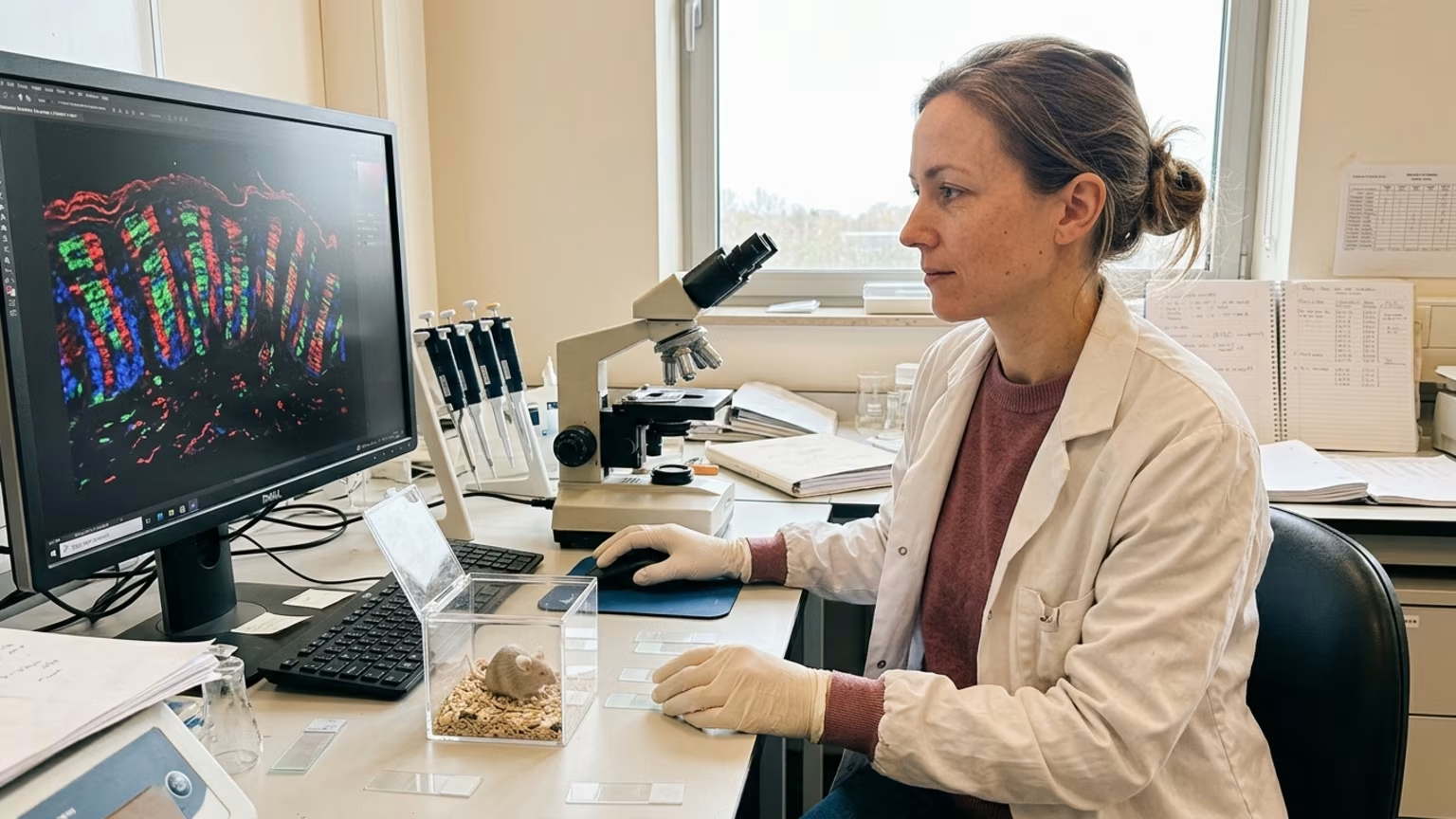

Raman and gene-expression data reveal senescence signatures in mouse skin. Learn how the collagen pathway findings differ from measured skin outcomes.





On September 22, 2026, Genetic Engineering & Biotechnology News (GEN) reported on researchers combining Raman microscopy with gene-expression data to identify cellular senescence “barcodes.” The work included mouse skin and connected the identification of senescent cells with changes in biological pathways involved in tissue remodeling.
For readers interested in collagen, one finding deserves attention: GEN reported significant changes in skin-cell pathways associated with collagen and extracellular-matrix remodeling. Understanding the distinction between a cellular signature and a measured collagen outcome is central to interpreting this research.
The approach brings together different types of information about cells. In GEN’s account, Raman measurements contribute biochemical information while gene-expression data contribute information about cellular programs. The researchers combined informative features from these measurements into a senescence-associated barcode.
Study co-senior author Jian Shu described the rationale as viewing senescence from “two complementary views,” according to GEN. That phrase captures the research question: what becomes clearer when investigators consider these measurements together rather than separately?
Co-first author Salvatore Sorrentino told GEN that combining Raman features with gene signatures created a barcode that could identify senescent cells “in a more unbiased way.” This is the researchers’ description of the approach and its purpose.
Here, “barcode” refers to a combined pattern in the measurements. It is useful shorthand for a research signature assembled from different kinds of cellular evidence. The scientific interest lies in connecting those observations so researchers can better characterize the cells they are studying.
That distinction also helps explain why the work belongs in a discussion of measurement. The central achievement described by GEN concerns identifying senescence-associated signatures. The collagen connection comes from the biological pathways examined alongside those signatures.
GEN reports that the study compared tissue from 2-month-old and 26-month-old mice. In the skin analysis, pathways associated with muscle contraction and collagen or extracellular-matrix remodeling were significantly affected.
Extracellular matrix is often shortened to ECM. Seeing “collagen/ECM remodeling” in a report signals that investigators are examining biological programs connected with tissue remodeling. It is important to preserve that level of description when translating the finding for a beauty audience.
The result creates a research connection between senescence-associated cell patterns and remodeling-related pathways in mouse skin. It gives investigators a way to consider cellular identification alongside gene-expression information rather than treating the barcode as an isolated observation.
This is also why the work is relevant to the broader relationship between senescence and collagen. Identifying a cell state and examining the biological programs associated with it are related research tasks. Measuring a change in the tissue itself is another task.
For readers, keeping those questions separate makes the finding easier to understand. The barcode concerns recognition of a cellular pattern. The pathway analysis concerns the biological programs associated with the cells being studied.
Several distinctions determine how far the findings can be taken. They concern the study model, the outcomes measured and the readiness of the technology.
The reported findings came from mouse tissue. GEN says researchers are working to adapt the method for human tissue; the reporting does not establish human-tissue validation or clinical testing. Results from the animal comparison therefore do not establish how the approach would perform in a person’s skin.
GEN does not report collagen protein measurements, the direction or size of a collagen change, or a skin-specific collagen Raman marker. The altered pathways consequently do not establish that skin gained or lost collagen. They also do not quantify changes in firmness, wrinkles or tissue resilience.
The word “significant” should stay attached to the reported pathway finding. It should not be translated into a claim about a noticeable improvement or deterioration in skin appearance.
According to GEN, the system took about 30 hours to analyze roughly one square millimeter of tissue. The report says this motivated work on a faster system. That workload places the method in an early research setting rather than routine consumer or clinical skin assessment.
Those numbers describe analysis time and tissue area. They are not measures of diagnostic accuracy or predictions of performance in everyday care.
The work described here did not test a topical product, collagen supplement or treatment for visible skin aging. It does not show that skincare, diet or other lifestyle measures change the barcode or reverse senescence in human skin. A method for identifying a biological pattern is a different kind of evidence from a study testing whether an intervention changes an outcome.
The practical value is interpretive rather than a reason to change a routine. This research offers a clearer way to sort the questions that often become compressed into a single beauty headline.
When assessing coverage of a cellular measurement, distinguish among these questions:
This separation is particularly useful when comparing laboratory research with evidence about collagen supplementation. A measurement study asks how to recognize or characterize a biological state. An intervention study asks what changes after an intervention.
Younell’s perspective is to keep those categories visible rather than allowing an interesting research tool to become a product promise. For personal skin concerns or treatment decisions, interpretation belongs with a qualified clinician who can consider the individual situation.
GEN reports that human-tissue adaptation is an active direction for the researchers. The immediate questions are therefore about measurement: how the combined signature behaves in human tissue and whether the method can become more practical to use.
The collagen question is equally specific. Future evidence would need to connect the cellular signature with measured collagen or skin outcomes before the barcode could support claims about those outcomes.
For now, the contribution is a research framework for linking cellular signatures with biological information in mouse tissue. Its value lies in making the questions about senescence and remodeling more precise, while leaving the human skin questions open.
Stay connected for research and practical guidance on skin, hair, collagen, nutrition and beauty longevity. Clear ideas for people who want to understand how appearance changes with age and make better-informed choices over time.


Understand your skin, hair and body better without chasing every new trend, treatment or promise.
explore the Blog


