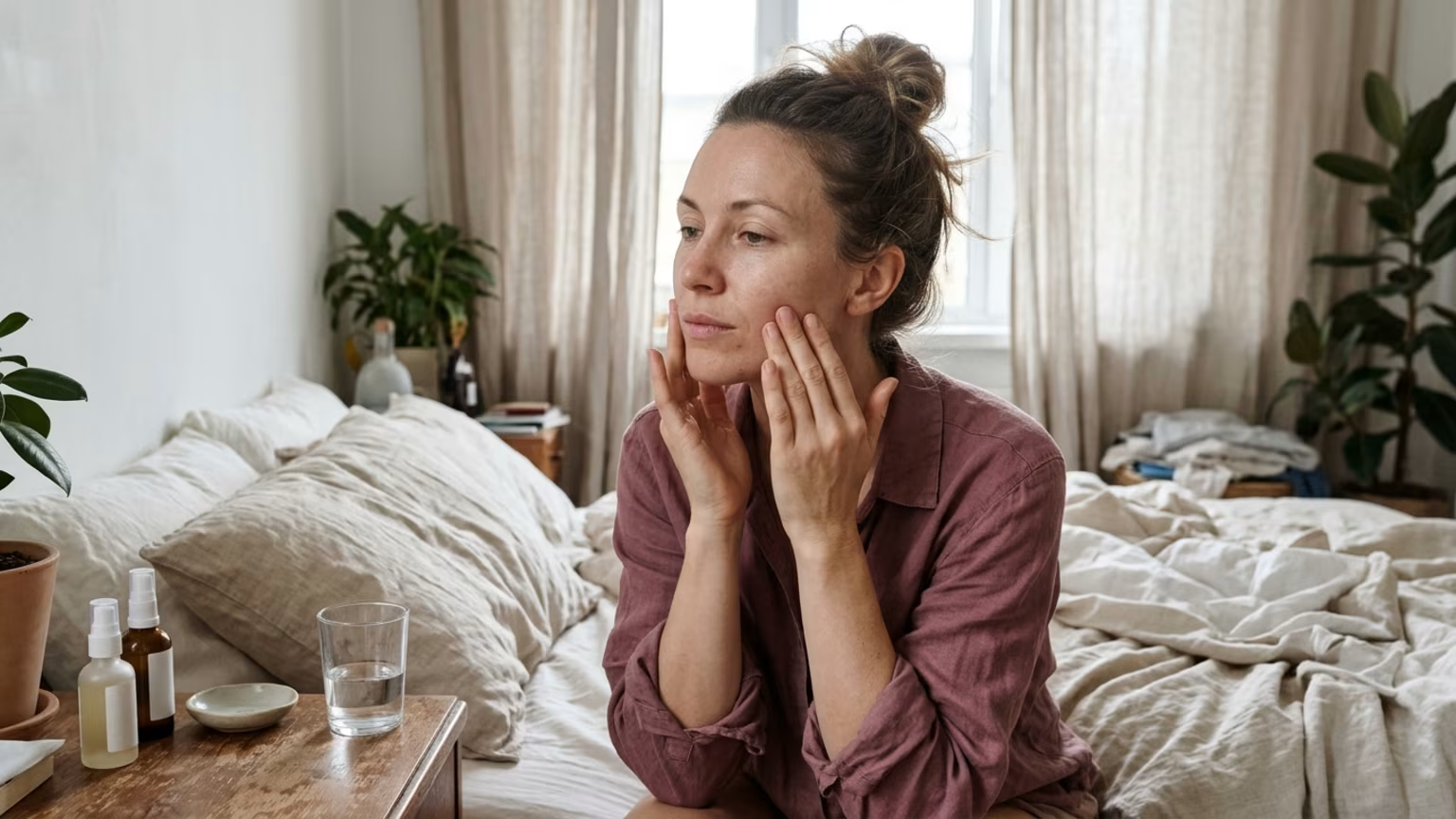

How stress may influence skin symptoms, why triggers differ, and what NIH guidance supports for low-pressure stress care alongside eczema care.





How does stress affect skin, and what helps? The science-backed answer is that stress can influence symptoms through interconnected biological responses, while useful support depends on the condition and the person.
That is a more helpful starting point than treating every breakout or uncomfortable patch as a report card on emotional balance. The strongest practical message is about support: understanding possible triggers, making room for manageable stress care and keeping appropriate skin care in view.
Stress may influence skin through interconnected nervous-system activity, hormonal signaling and immune responses. The research supports this broad framework rather than a single explanation for every stress-associated skin change.
The biological discussion in a 2026 JMIR Dermatology analysis describes psychological stress as associated with acne, psoriasis, urticaria and eczema. It identifies stress-related immune changes, inflammatory signaling and skin-barrier disruption as processes that may worsen some conditions. The analysis itself examined public interest across periods before, during and after the COVID-19 pandemic.
The useful distinction is between a cause and a modifier. Calling stress a modifier means it may influence symptoms or disease activity without being the original or only reason a condition exists. That leaves room for the other contributors that matter in an individual case.
It also avoids reducing the biology to one hormone or pathway. Nervous, hormonal and immune responses belong to an interconnected picture. A simple explanation may be appealing, but the research does not identify one mechanism that accounts for everyone's skin response.
Barrier disruption is one part of this discussion rather than a complete explanation. For a separate look at everyday skin care, Younell's resource on hydration and barrier support addresses that side of the picture.
Responses differ because stress is only one possible influence, and triggers vary between people. The clearest condition-specific guidance in these sources concerns eczema.
NIH guidance on eczema lists emotional stress among possible flare triggers. It also identifies environmental exposures and irritants as potential contributors. Someone else's experience therefore does not provide a reliable explanation for your own symptoms.
This makes personal patterns worth noticing without turning them into conclusions. A flare that happens during a demanding period may suggest a question to discuss with a clinician. Timing alone does not prove that stress caused it, particularly when other possible triggers are present.
A low-pressure way to think about patterns is to keep the question open: did symptoms change alongside stress, or were other exposures changing too? The purpose is to provide context rather than to assign responsibility. Such observations are not a diagnosis.
That distinction also matters emotionally. The NIH's description of multiple possible triggers does not support treating skin symptoms as evidence that someone has failed to manage life well. Understanding a possible influence is different from being able to control it completely.
These sources do not establish that lowering stress preserves collagen or produces a predictable change in visible aging. They also do not establish that chronic stress causes skin aging or collagen loss.
This is where evidence about symptoms needs to stay separate from beauty marketing. A discussion of possible eczema flares does not demonstrate a benefit for wrinkles. Likewise, an association between stress and a skin condition does not establish that a stress-management practice changes long-term appearance.
The JMIR Dermatology study's focus on public interest is relevant here. Studying attention to stress-associated conditions is different from testing an intervention against a skin outcome. Its findings should not be presented as proof that a particular routine improves skin.
A useful editorial test is to ask what outcome a claim actually concerns. Lower stress, fewer eczema flares and changes in collagen are different claims. Evidence supporting one should not be quietly stretched to support the others.
For readers interested in that separate topic, Younell's discussion of how to assess collagen supplement evidence keeps the focus on specific outcomes. Beauty longevity is better served by that precision than by turning general well-being advice into an appearance promise.
NIH guidance says stress-management and relaxation techniques may help lower stress and decrease the likelihood of eczema flares. This supports considering them as additions to broader care rather than replacements for prescribed treatment or professional assessment.
The guidance does not prescribe one required method or duration. The available evidence also does not establish a single routine that works for every person or skin condition. That leaves room for an approach based on what feels manageable rather than on a demanding schedule.
A low-pressure interpretation of the guidance has several parts:
There is no need to make skin appearance the sole measure of whether support feels worthwhile. A person can consider whether a practice is helpful or burdensome without treating every symptom change as a verdict on the practice.
The practical emphasis is flexibility. Choosing something manageable and continuing only if it feels helpful is more consistent with this guidance than insisting on one supposedly essential routine.
NIH guidance recommends talking with a doctor when eczema-related itch disrupts sleep. It also suggests considering counseling when the condition leaves someone feeling overwhelmed or anxious.
These are distinct reasons for support. A doctor can address the skin-care concerns behind disrupted sleep, while counseling can provide help with the emotional burden described in the guidance. Neither need should be dismissed as simply a matter of trying harder to relax.
Personal decisions about symptoms and treatment belong with qualified care. Stress can be part of that conversation without becoming the explanation for everything. Support from trusted people can sit alongside professional help rather than competing with it.
Your curiosity about stress and skin is valid; beauty longevity means supporting well-being over time without making every flare a personal verdict.
Stay connected for research and practical guidance on skin, hair, collagen, nutrition and beauty longevity. Clear ideas for people who want to understand how appearance changes with age and make better-informed choices over time.


Understand your skin, hair and body better without chasing every new trend, treatment or promise.
explore the Blog