

Learn how collagen supports skin strength, elastin contributes recoil and the wider dermal matrix puts firmness claims into context.





At its core, the skin scaffold is the dermal extracellular matrix: a multi-component environment that gives skin structural support. Collagen contributes mechanical strength, while elastin contributes elasticity. They work within a larger system rather than acting as interchangeable ingredients.
That system includes collagens, elastin, proteoglycans and glycoproteins. As described in research on dermal fibroblasts, these cells synthesize and maintain the matrix.
Understanding that distinction changes how to read a promise of firmer skin. A claim about one protein is not automatically a claim about the condition of the whole scaffold.
Collagen’s role is mechanical strength: helping the dermis resist deformation under force. Elastin’s role is elasticity, which concerns how tissue recoils after it has been stretched. Both matter to structure, but strength and recoil describe different properties.
Fibroblasts provide the maintenance side of this picture. They synthesize and maintain a matrix containing multiple components. The scaffold is therefore living tissue infrastructure, not a fixed store of collagen that can be understood by quantity alone.
This is why a collagen claim needs a specific endpoint. Evidence about strength does not automatically establish better elasticity. A useful explanation of firmness has to say which property it means, rather than treating the words as equivalents.
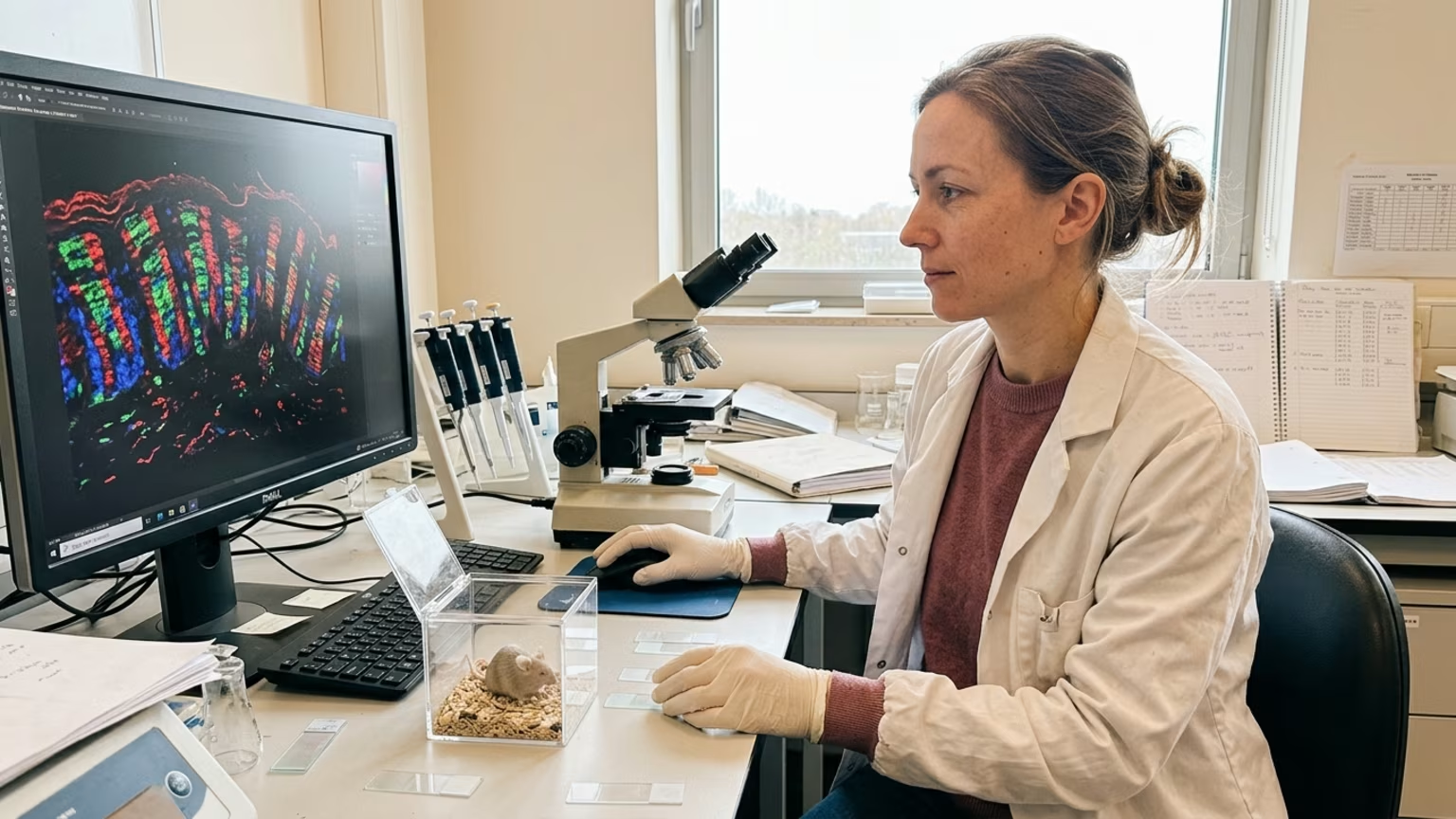
A 2026 study in Dermatology and Therapy examined facial skin structure in 547 healthy Chinese women aged 18 to 65. Researchers used two-photon microscopy and ultrasound to compare five age groups.
Older groups showed lower collagen-related signals and dermal fiber patterns that were less organized and more fragmented. Elastin-related signals were more prominent but increasingly irregular. Dermal density was also lower, with several structural differences becoming more evident from the 36 to 45 age group onward.
The study also reported higher relative elastin-to-collagen measures in older groups. A relative measure describes the relationship between those signals; it is not a direct assessment of how well skin recoils. Read alongside the increasingly irregular fiber patterns, the result is a reminder that a stronger signal does not necessarily mean a better-organized scaffold.
These were cross-sectional comparisons, not repeated observations of the same women over time. Participants came from three Chinese cities, and imaging covered a limited area and depth rather than the full deeper dermal architecture. The authors also noted that interobserver reproducibility was not assessed, meaning consistency between different observers was not evaluated. Together these limits mean the findings do not establish a universal aging timetable or explain what caused the differences.
Younell’s whole-person perspective places nutrition and lifestyle alongside skin biology, rather than treating collagen as an isolated beauty target. That means asking how an outside influence is connected to the structural outcome being discussed.
For a nutrition claim, look for evidence that measured a dietary change and a relevant skin endpoint. For UV exposure, look for research directly examining exposure and dermal structure. For stress, distinguish a measured association from evidence that changing stress changes the matrix.
Those are evidence standards, not claims that these factors affect every matrix component in the same way. The facial-imaging study does not establish a particular food choice or stress practice as a way to change collagen or elastin.
For related context, Younell’s discussions of food patterns and skin health and the evidence around sleep and daily habits keep the focus on wider lifestyle questions. A holistic approach should broaden the questions being asked, not lower the standard of proof.
A quick visual result and a lasting structural change are different kinds of claim. Neither the word “firmness” nor a reference to collagen tells you which one was evaluated. The distinction matters even when a result sounds encouraging.
Supporting a maintained biological system is a long-term frame, not a promise of rapid reconstruction. The studies discussed here do not test a particular supplement, topical product or procedure for restoring the scaffold. They provide no validated timetable for doing so.
Instead of judging a claim by the speed of its promised result, look for alignment between the evidence and the wording:
Younell’s review of evidence behind oral collagen claims offers related reading on this distinction. For personal decisions about skin concerns or interventions, a qualified healthcare professional can help put the evidence in context.
The sustainable perspective is not that the scaffold never changes. It is that strength, recoil and matrix organization deserve separate attention over time. A single protein or an impressive result on one test is not a complete description of skin health.
Key Takeaway: Collagen contributes strength and elastin contributes recoil within a matrix maintained by fibroblasts, so long-term skin health is better understood as a whole-system question than a single-protein target.
Stay connected for research and practical guidance on skin, hair, collagen, nutrition and beauty longevity. Clear ideas for people who want to understand how appearance changes with age and make better-informed choices over time.



Understand your skin, hair and body better without chasing every new trend, treatment or promise.
explore the Blog