

We review the 2026 clinical data behind everyday collagen routines, separating the convenience of daily powders from the mixed evidence on skin and joints.





In September 2026, a consumer feature published by USA Today Shopping illustrated how oral collagen has smoothly transitioned into everyday wellness routines. The coverage highlighted Great Lakes Wellness products. It specifically pointed to their unflavored collagen-peptide powders, portable stick packs, and marine options. The article presented the supplement as a highly convenient addition to morning coffee, daily smoothies, and familiar recipes.
Rather than evaluating clinical efficacy, the publication focused heavily on habit formation and format variety. Consumers are increasingly drawn to portable options that promise to support skin, hair, nails, and general wellness without demanding extra time. The underlying commercial logic presented by USA Today is that supplements are easier to maintain when they fit naturally into familiar habits.
This focus reflects a broader shift in how women approach healthy aging. We are seeing a move away from specialized routines toward accessible daily rituals. The featured stick packs, for example, are presented as pre-portioned servings intended for gym bags, travel, and office commuting. However, popularity does not automatically equal clinical proof. We must separate the appeal of an easily dissolved powder from the biological reality of what happens inside the human body. A popular or convenient product simply does not mean it is proven effective.
To understand how these powders function, we have to look closely at the biological mechanism of oral supplementation. When you consume a collagen product, your digestive system breaks the complex protein down into smaller peptides and individual amino acids. Your body then absorbs these microscopic components through the intestinal wall and sends them directly into the bloodstream. The popular commercial theory suggests that these circulating amino acids travel directly to your dermal layer to rebuild a deteriorating structural matrix. This idea implies that oral consumption is essentially a straightforward building project.
Many consumers assume this process works exactly like a direct delivery service for their complexion. Unfortunately, human biology is rarely that simple or straightforward. Consuming a specific structural protein does not guarantee that your body will use those precise building blocks to firm your skin or strengthen your hair. Your system continually distributes essential nutrients based on strict internal metabolic priorities. If your body senses damage in a vital organ, it will redirect those resources immediately.
This means the peptides from your morning coffee might support internal tissue repair instead of reducing visible facial lines. This internal distribution process explains why clinical results often differ so drastically from enthusiastic marketing claims.
The clinical data behind oral supplementation presents a notably mixed picture when you look past the headlines. According to a 2025 trade report by the Food Institute, one meta-analysis reviewed 10 randomized controlled trials involving 646 participants. That review found notable improvements in skin hydration and elasticity at daily doses ranging from 1 to 10 grams, with a median dose of 3.5 grams. These initial figures seem to support the idea that daily supplementation offers cosmetic advantages.
A separate 2025 systematic review attributed to Myung and Park evaluated 23 randomized trials with 1,474 participants. That larger analysis initially reported favorable changes in skin hydration, elasticity, and visible wrinkling across the pooled data. However, the apparent skin benefits weakened or disappeared entirely when researchers restricted their analysis to higher-quality studies or trials without pharmaceutical-industry funding. The Food Institute report noted a similar trend, observing that favorable outcomes became far less persuasive without industry funding.
The uncertainty surrounding these findings highlights significant limitations in the current body of research. The 2025 review attributed to Myung and Park ultimately concluded that current clinical evidence does not support using collagen supplements to treat skin aging once methodological quality and funding biases are considered. Furthermore, the available USA Today article does not quote an independent dermatologist, clinical researcher, or physician to validate the featured beauty claims. Many consumer articles simply assume that a product's ability to dissolve quickly in coffee translates to visible structural changes.
The evidence for joint support should also be kept completely separate from cosmetic claims. The Food Institute detailed a 2025 meta-analysis of 11 randomized trials that showed significant improvements in pain and function for 870 people with knee osteoarthritis. Those positive results still varied substantially between studies. This specific joint data does not prove that the supplement prevents arthritis, rebuilds healthy cartilage, or improves comfort for every healthy consumer.
When we first started reviewing clinical trials on collagen supplementation, I was struck by how often the media misinterpreted the data. A study showing a minor change in skin elasticity was suddenly headlined as a profound breakthrough. It made me realize how desperately consumers need a translator for beauty science, someone who can say exactly what a study proves and what it does not prove. This experience shaped our commitment at Younell to clearly state when evidence is mixed.
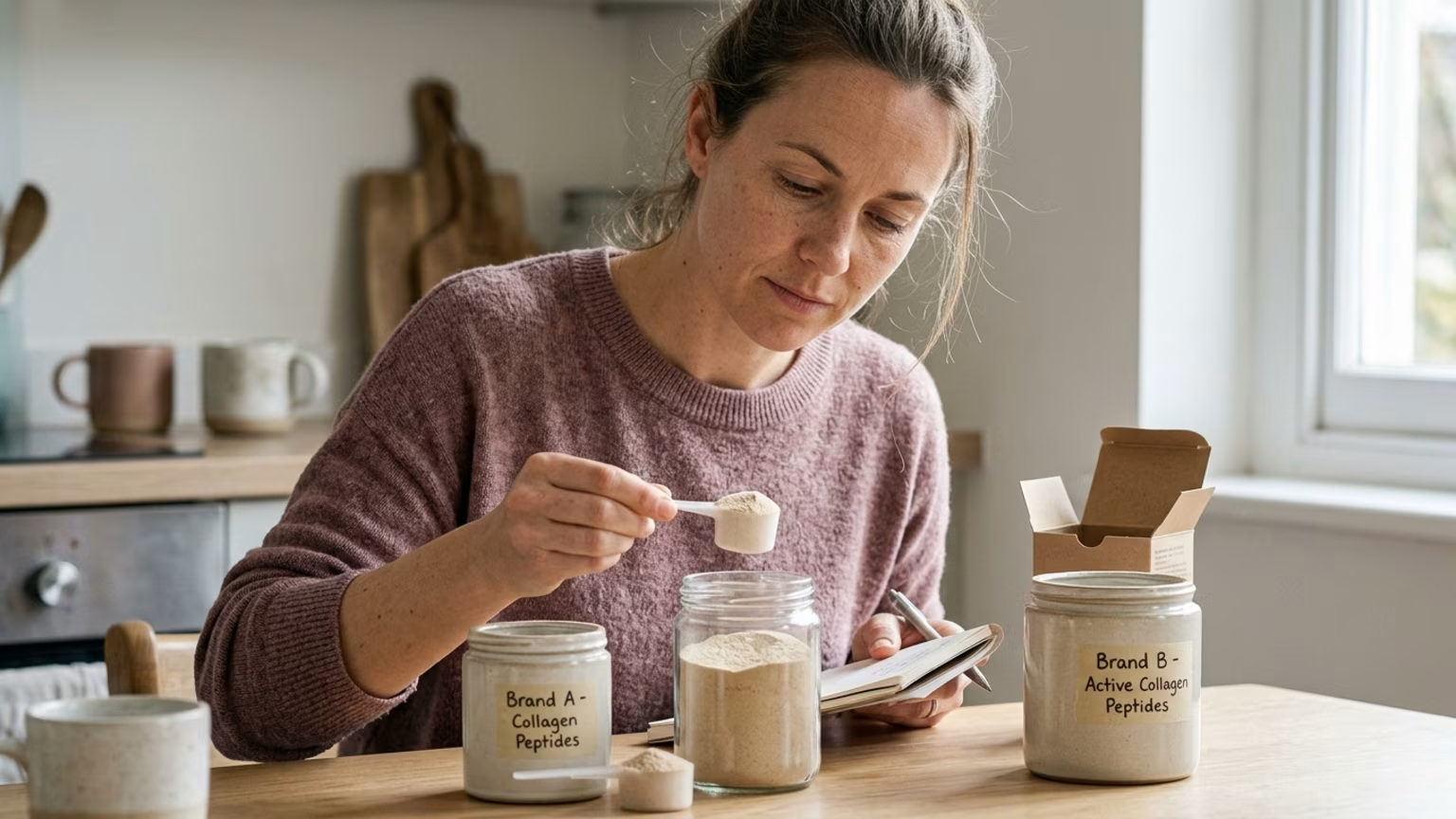
Health-conscious women can still incorporate these supplements into their routines if they maintain realistic expectations. You should treat unflavored powders or portable stick packs as optional dietary additions rather than primary care strategies. If convenience is your deciding factor, compare serving sizes, ingredient lists, and total daily costs instead of assuming a marine-sourced product is automatically superior. The sources do not establish that marine collagen is better than bovine alternatives, nor do they confirm a universally effective dose.
It is incredibly essential to evaluate your supplement choices within the broader context of your overall lifestyle. Adequate daily protein intake, regular physical activity, consistent high-quality sleep, and daily sun protection remain far more important than any single powdered additive. Track your personal results over a defined period of a few months, and feel perfectly confident stopping the routine if you notice no meaningful changes. Do not automatically infer hair or nail results from isolated skin studies, as the available clinical sources absolutely do not establish that these outcomes naturally translate.
Women managing chronic allergies, specific dietary restrictions, or regular daily medication use should always consult a qualified healthcare professional before starting any new daily habit. If you experience persistent joint pain, unusual swelling, or noticeably reduced mobility, seek a proper medical assessment rather than relying on self-treatment with a dietary product. Use cautious and realistic language when setting your personal health goals. You should remember that measured expectations are far more defensible than dramatic claims about completely reversing natural bodily changes.
As mainstream publications continue to highlight convenient dietary habits, the gap between commercial popularity and rigorous scientific validation remains wide open. Will future clinical research finally establish a universally effective dose, or will personalized nutrition guidelines ultimately dictate how we approach long-term tissue health from within?
Stay connected for research and practical guidance on skin, hair, collagen, nutrition and beauty longevity. Clear ideas for people who want to understand how appearance changes with age and make better-informed choices over time.



Understand your skin, hair and body better without chasing every new trend, treatment or promise.
explore the Blog